Counterfeit $10 Banco Nacional de México notes
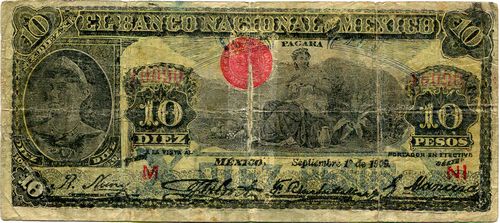
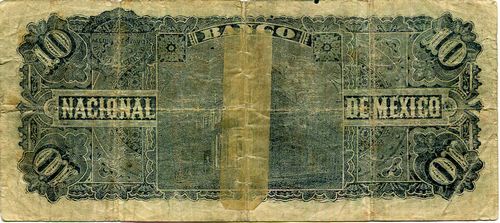
A counterfeit $10 note from the American Bank Note Company's security and counterfeit protection reference collection
There are several references to counterfeit $10 notes, from January 1911 onwards, all of which probably refer to the same operation. At the same time, a separate large-scale counterfeit operation was being foiled, before any notes were put into circulation.
In January 1911 the newspaper Iberia reported on two counterfeit $10 notes. The two holders had been arrested but refused to confess to the origin of the notes, so the matter was passed to Francisco Chávez, the First Chief of the Reserved Police (Primer jefe de la Policía Reservada). Chávez, with his agents, finally discovered the origin of the notes.
These notes were described as poor imitations that would only fool the most ignorant people. “The face was badly printed with too much ink on the black lettering. The note’s number and series were indistinct, and too reddish. The signatures were illegible and looked like blobs of black ink. On the reverse, with the vignette of the bank’s building, the blue colour was washed out and the figures engraved on the border were very thick and loaded with ink, in contrast to the printing of the centre. The only thing identical with the legitimate notes was the linen paper on which they were printed (La primera cara del billete está muy mal impresa y los caracteres de las letras muy cargados de tinta negra, circunstancia que los hace desde luego sospechosos. Además, el número de orden del billete así como el de la series á que pertenece no se distinguen, apenas se ven muchas rojizas. Las firmas que calzan el billete no son legibles, sino que parecen manchones de tinta negra. En el reverso del billete que tiene grabada la fachada del Banco Nacional, puede verse, que el color azul, está muy deslavado y las figuras que orlan el grabado muy gruesas y muy cargadas de tinta, contrastando con la impresión del centro. Estos billetes. Podrán pasar entre gentes muy ignorantes solamente. Lo único que sí es idéntico á los billetes legales, es el papel de lino en que están impresos.)”Iberia, Año V, Núm. 1402, 8 January 1911.
In late January counterfeit $10 notes were reported in Pachuca. More than $300 was collected by the police and the authorities began an investigationEl Tiempo, Año XXVIII, Núm. 9064, 21 January 1911: El Imparcial, Tomo XXX, Núm. 6138, 21 January 1911. In the same month around $400 in such notes had turned up in Puebla. The counterfeits were hard to recognize but differed in colour from the genuine article (billetes falso, que, en conjunto, no es fácil conocer; pero que ya aislados, difieren por el color, de los legítimos)El Heraldo Mexicano, Núm. 92, 31 January 1911.
Javier M. Cancino. Manager of the Banco Nacional de México, when questioned about the counterfeiting, said: "One of these banknotes was sent to us from Pachuca, another from Puebla and another we found in this city. These notes are a crude imitation of the originals and were evidently taken with photographs. The colours are not nearly like the originals. All the notes we have received have been handed over to the police, who are working hard and actively to determine who is responsible for the counterfeiting and where these notes come from. We do not intend for now to change the engraving of our banknotes, because those that circulate counterfeit are so badly made that no one can confuse them with the legitimate ones.”El Heraldo Mexicano, Núm. 94, 2 February 1911.
Other reports might refer to different attempts. Thus, in January 1912 several people who caught circulating counterfeit $10 notes in PueblaEl Tiempo, 19 January 1912.
In April 1913 three men were arrested in Pachuca, Hidalgo, for forging $10,000 in $10 Banco Nacional de México notes. On 16 July 1913 María Asunción Guevara was arrested whilst trying to pass a good imitation of a $10 note. She had some other $10 notes and one $5 note. The public was warned to take care when receiving these two denominationsEl País, 17 July 1913. In October 1913 the police were on the trail of someone passing notes in TolucaEl Independiente, Año I, Núm. 245, 24 October 1913.
In February 1915 the police arrested someone with three counterfeit $10 notes. The principal distinguishing features were the typeface was smudged, the figures were the same as the letter, unclear, and the signatures were imperfect (Los billetes falsos recogidos son de diez pesos, tienen en la cara que dice Banco Nacional de México, borrados los tipos, y las figuras están de la misma manera que la letra, poco claras. Las firmas de los billetes falsos son imperfectas, y además existen algunas otras diferencias, que aunque son de menor importancia, no pasan por alto, pues que son fácilmente visibles)La Prensa, Año I, Tomo I, Núm. 13, 19 February 1915. The next day the police arrested Agustín Aguilar, Abel Ramírez and Leonardo Ballesteros, who tried to pass some of these notes in a restaurant in the Calle de Santo DomingoLa Prensa, Año I, Tomo I, Núm. 14, 20 February 1915.