American Bank Note Company print runs
The ABNC engraved a special vignette of a female head, entitled "Mexico", (C 94) for all the values.
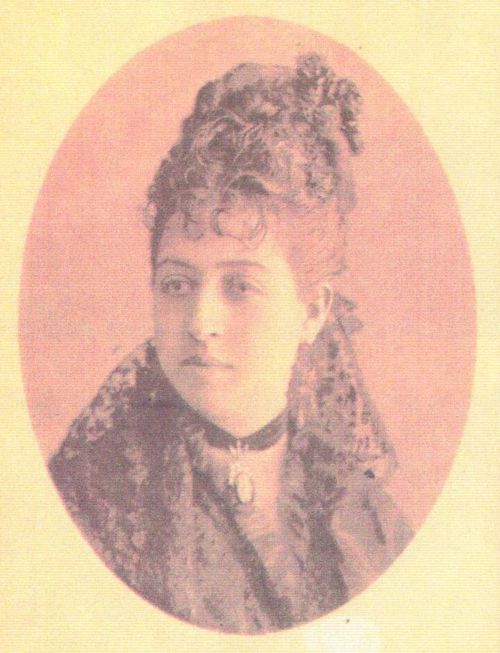 A photograph of a Mexican lady from the ABNC archives
The production material in the ABNC archives included two photographs of ladies with notations on the back “this is typically Mexican but not handsome enough” and “This is also Mexican type but not handsome” and the actual vignette was of the leading socialite Manuela García-Teruel y MansoA widely known story is that the President of the bank, Antonio Mier y Celis, was one of Manuela García-Teruel y Manso’s suitors. He asked her for a portrait to carry with him but she refused. Feeling dismayed he obtained her portrait from one of the members of her household and, as a revenge, used it for the vignette for the bank. He argued that if she would not be his, then her portrait would be in the hands of every citizen. A more noble and romantic version states that he did this to gain her favour.. The ABNC used vignette C 231 for the $10 note and vignette C 212 for the $50. Originally the dateline "MÉXICO.................de 188." was engraved on all banknotes.
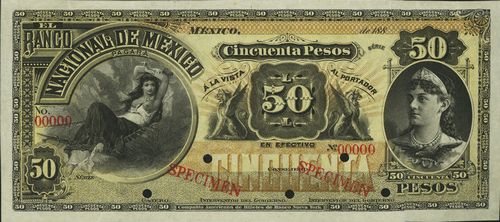
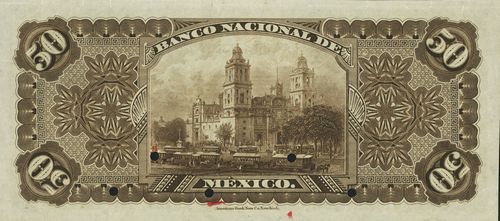 M301s $50 Banco Nacional de México specimen
| Date | Value | Series | from | to | |
| September 1884 | $1 | 200,000 | 1 | 200000 | |
| $2 | 50,000 | 1 | 50000 | ||
| $5 | 200,000 | 1 | 200000 | ||
| $10 | 200,000 | 1 | 200000 | ||
| $20 | 50,000 | 1 | 50000 | ||
| $50 | 30,000 | 1 | 30000 | ||
| $100 | 50,000 | 1 | 50000 | ||
| $500 | 1,200 | 1 | 1200 | ||
| $1,000 | 600 | 1 | 600 |
On 2 January 1885 José V. del Collado, the director, and Ramón Usandizaga, the cashier (cajero) acknowledged that they had received on the steamship "Capules" the first consignment of $460,000 in notes, viz. 30,000 $1 (000001-030000), 30,000 $5 (000001- 030000), 20,000 $10 (000001- 020000) and 4,000 $20 (00001-04000). The same month the steamship "City of Washington" arrived in Veracruz with another 30,000 $1(030001-060000), 30,000 $5 (030001 to 060000), 28,000 $10 (020001-048000), 12,000 $20 (04001- 016000) and 8,000 $50 (00001- 08000). And on 30 January the director acknowledged receiving another two cases in the "City of Alexandria". Up to March 1885 the bank had received all the notes except for 18,000 $50 notesABNC.
| Date | Value | Series | from | to | |
| February 1887 | $1 | 100,000 | 200001 | 300000 | |
| $20 | 10,000 | 50001 | 60000 | ||
| $50 | 12,000 | 30001 | 42000 | ||
| $100 | 31,000 | 50001 | 81000 | ||
| $500 | 4,000 | 1201 | 5200 | ||
| $1,000 | 2,000 | 601 | 2600 |
| Date | Value | Series | from | to | |
| November 1888 | $1 | 200,000 | 300001 | 500000 | |
| $5 | 120,000 | 200001 | 320000 | ||
| $10 | 170,000 | 200001 | 370000 | ||
| $20 | 50,000 | 60001 | 110000 | ||
| $50 | 30,000 | 42001 | 72000 | ||
| $100 | 50,000 | 81001 | 131000 |
The dateline "MÉXICO.................de 189." was engraved on all banknotes
| Date | Value | Series | from | to | |
| February 1893 | $5 | 200,000 | 320001 | 520000 |
| Date | Value | Series | from | to | |
| September 1896 | $5 | 100,000 | 520001 | 620000 | |
| $10 | 300,000 | 370001 | 670000 | ||
| $20 | 25,000 | 110001 | 135000 | ||
| $50 | 20,000 | 72001 | 92000 | ||
| $100 | 30,000 | 131001 | 161000 | ||
| $500 | 2,000 | 5201 | 7200 | ||
| $1,000 | 1,000 | 2601 | 3600 |
The dateline was changed once again to "MÉXICO.................".
| Date | Value | Series | from | to | |
| February 1900 | $5 | 200,000 | 620001 | 820000 | |
| $10 | 100,000 | 670001 | 770000 | ||
| $20 | 50,000 | 135001 | 185000 | ||
| $50 | 20,000 | 92001 | 112000 | ||
| $100 | 20,000 | 161001 | 181000 | ||
| $500 | 4,000 | 7201 | 11200 | ||
| $1,000 | 2,000 | 3601 | 5600 |
| Date | Value | Series | from | to | |
| March 1902 | $5 | 300,000 | 820001 | 1120000 | |
| $10 | 150,000 | 770001 | 920000 | ||
| $20 | 25,000 | 185001 | 210000 | ||
| $50 | 10,000 | 112001 | 122000 | ||
| $100 | 20,000 | 181001 | 201000 | ||
| $500 | 4,000 | 11201 | 15200 | ||
| $1,000 | 2,000 | 5601 | 7600 |
On 22 February 1905 the bank ordered another 1,602,000 notes with a total value of $20,000,000ABNC, folder 158, Banco Nacional de México (1904-1912).
| Date | Value | Series | from | to | |
| March 1905 | $5 | 900,000 | 1120001 | 2020000 | |
| $10 | 450,000 | 920001 | 1370000 | ||
| $20 | 225,000 | 210001 | 435000 | ||
| $50 | 10,000 | 122001 | 132000 | ||
| $100 | 10,000 | 201001 | 211000 | ||
| $500 | 4,000 | 15201 | 19200 | ||
| $1,000 | 3,000 | 7601 | 10600 |
On 25 May the ABNC shipped to the Veracruz branch, on the S.S. “Monterey”, 24,000 $5 (1120001-1144000) 4,000 $50 (122001-126000) and 1,000 $500 (15201-16200). On 8 June it sent on the steamer “Vigilancia” 48,000 $5 (1144001-1192000), 18,000 $10 (920001-938000), 6,000 $50 (126001-132000), 8.000 $100 (201001-209000), 2,000 $500 (16201-18200) and 2.500 $1,000 (7601-10100). On 15 June it sent on the S. S. “Yucatan” 64,000 $5 (1192001-1256000), 80,000 $10 (938001-1018000), and on 22 June, on the “Monterey”, 64,000 $5 (1256001-1320000) and 48,000 $10 (1018001-1066000). On 29 June it sent, via the S.S. “Esperanza” 48,000 $5 (1320001-1368000), 68,000 $10 (1066001-1132000), 12,000 $20 (210001-222000) and 1,000 $500 (18201-19200). On 6 July the “Vigilancia” carried 40,000 $5 (1368001-1408000), 48,000 $10 (1132001-1180000), 60,000 $20 (222001-282000) and 2,000 $100 (209001-211000).
On 13 July the ABNC sent, on the steamer “Yucatan” 16,000 $5 (1408001-1424000), 18,000 $10 (1180001-1198000) and 18,000 $20 (282001-300000) and on 27 July, via the “Esperanza” 56,000 $5 (1424001-1480000), 12,000 $10 (1198001-1210000) and 63,000 $20 (300001-363000). On 10 August the “Yucatan” carried 150,000 $5 (1480001-1630000), 50,000 $10 (1210001-1260000) and 40,000 $20 (363001-403000). On 22 August, it shipped on S.S. “Esperanza” 250,000 $5 (1630001-1880000), 40,000 $10 (1260001-1300000) and 22,000 $20 (403001-435000). Finally, it completed the order on 15 September by shipping, on the steamer “Yucatan” 140,000 $5 (1880001-2020000), 70,000 $10 (1300001-1370000) and 500 $1,000 (10101-10600).
The last five boxes arrived by 6 October.
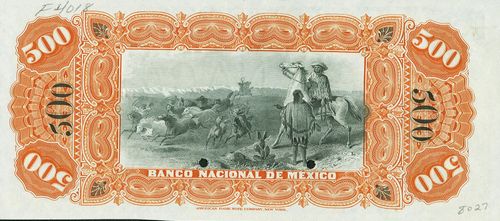 M304s $500 Banco Nacional de México specimen
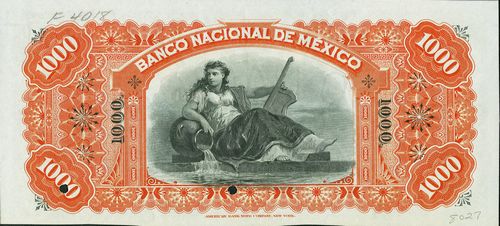
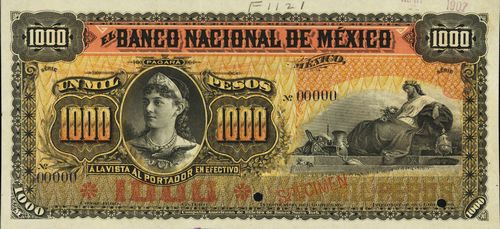 M305s $1,000 Banco Nacional de México specimen
| Date | Value | Series | from | to | |
| March 1907 | $5 | 2,200,000 | 2020001 | 4220000 | |
| $10 | 500,000 | 1370001 | 1870000 | ||
| $20 | 250,000 | 435001 | 685000 | ||
| $50 | 100,000 | 132001 | 232000 | ||
| $100 | 20,000 | 211001 | 231000 | ||
| $500 | 2,000 | 19201 | 21200 | ||
| $1,000 | 1,000 | 10601 | 11600 |
On 27 June 1907 the ABNC shipped, by the S.S. “Esperanza”, 250,000 $5 (2020001-2270000) and on 11 July, again by the S. S. “Esperanza”, another 250,000 $5 (2270001-2520000). On 25 July it sent, via the “Esperanza”, 350 $5 (2520001-2870000) and 150,000 $10 (1370001-1520000) and on 8 August, on S.S. “Monterey”, 300,000 $5 (2870001-3170000) and 150,000 $10 (1520001-1570000).
On 22 August the ABNC sent, per the steamship “Morro Castle”, 400,000 $5 (3170001-3570000), 144,000 $10 (1670001-1814000), 2,000 $500 (19201-212000) and 1,000 $1,000 (10601-116000); on 5 September, per the “Monterey”, 100,000 $5 (3570001-3670000) and 56,000 $10 (1814001-1870000); on 19 September, per the “Esperanza”, 250,000 $5 (3670001-39200000 and 40,000 $20 (435001- 475000); on 3 October, per S.S. “Monterey”, 200,000 $5 (3920001-4120000) and 160,000 $20 (475001- 635000); and on 24 October, by the “Mexico” 100,000 $5 (4120001-4220000), 50,000 $20 (635001-685000), 100,000 $50 (132001-232000) and 4,000 $100 (211001-215000). Finally, it completed the order by shipping. on 31 October, per S.S. “Monterey”, 16,000 $100 (215001-231000).
| Date | Value | Series | from | to | |
| April 1910 | $5 | 2,000,000 | 4220001 | 6220000 | |
| $10 | 1,000,000 | 1870001 | 2870000 | ||
| $20 | 500,000 | 685001 | 1185000 | ||
| $50 | 120,000 | 232001 | 352000 | ||
| $100 | 100,000 | 231001 | 331000 | ||
| $500 | 4,000 | 21201 | 25200 | ||
| $1,000 | 2,000 | 11601 | 13600 |
Because the bank was in urgent need of $500 and $1,000 notes, the ABNC sent, on 1 July, by Wells Fargo & Co’s Express to Mexico City, a box containing 3,500 $500 (21301-24700) and 1,500 $1,000 (11601-12100). The rest of the order was sent, by Ward Line, to the bank’s branch in Veracruz.
On 11 August the ABNC sent, per S.S. “Merida”, 100,000 $100 (231001-3310000), 500 $500 (24701-25200) and 500 $1,000 (15101-15600). On 28 September it shipped, per S.S. “Monterrey”, 50,000 $10 (1870001-192000), 100,000 $20 (685001-785000) and 120,000 $50 (232001-352000). On 28 October it sent, on the S.S. “Monterey”. 200,000 $5 (4220001-4420000), 100,000 $10 (1920001-2020000) and 100,000 $20 (785001-885000).
On 18 November it sent, on the “Mexico”, 500,000 $5 (4420001-4920000), 100,000 $10 (2020001-2120000) and 100,000 $20 (885001-985000); on 2 December, on the S.S. “Mexico” 100,000 $5 (4920001-5020000), 400,000 $10 (2120001-2520000) and 200,000 $20 (985001-1185000); on 29 December, per S.S. “Merida”, 300,000 $5 (5020001-5320000) and 350,000 $10 (2520001-2870000); on 21 January 1911, per S.S. “Morro Castle”, 150,000 $5 (5320001-5470000); on 4 February, per S.S. “Esperanza”, 200,000 $5 (5470001-5670000); and on 23 February, on the “Merida”, 550,000 $5 (5670001-6220000), completing the order.
On 15 April 1913 the bank made a large order of 607,500 notes in four denominations (500,000 $10, 100,000 $50, 5,000 $50 and 2,500 $1,000), with an urgent desire to receive the higher value notes. However, on 10 May, Blackmore wired that the ABNC should cancel this order and substitute one for 20,000 $50, 4,000 $500 and 2,000 $1,000). The ABNC print records has the following:
| Date | Value | Series | from | to | |
| April 1913 | $10 | 1,000,000 | 2870001 | 3870000 | |
| $50 | 50,000 | 352001 | 402000 | ||
| $500 | 4,000 | 25201 | 29200 | ||
| $1,000 | 2,000 | 13601 | 15600 |
but considering that only the higher value notes were delivered to Mexico, and there is no further mention of a reduced order for $10 notes, it is fair to assume that they were never printed.
On 13 August the ABNC shipped per steamer via Veracruz, 50,000 $50 (352001-402000) and on 28 August, a box containing 4,000 $500 (25201-292000) and 2,000 $1,000 (13601-15600), completing the order.
| Date | Value | Series | from | to | |
| September 1913 | $500 | 7,000 | 29201 | 36000 | |
| $1,000 | 3,500 | 15601 | 19100 |
These were shipped to the bank, via Veracruz, on 8 OctoberABNC, folder 158, Banco Nacional de México (1913).
In May 1913 the ABNC engraved special vignettes of the national coat-of-arms (C 1363) and Chapultepec castle (C 1369) for a $100 note.
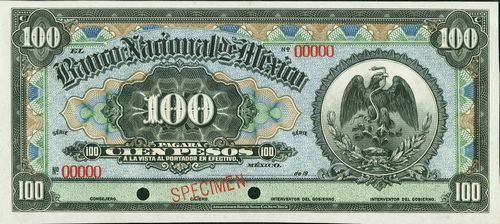
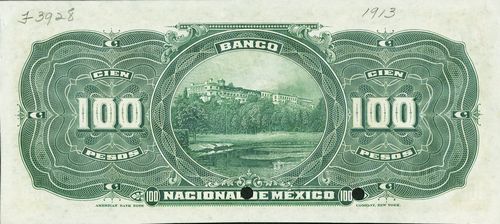 M303s $100 Banco Nacional de México specimen
and on 22 October the bank ordered 100,000 of these notes.
| Date | Value | Series | from | to | |
| October 1913 | $100 | 100,000 | 1 | 100000 |
However, due to delays, these notes were not dispatched until April 1914. On 9 April the ABNC sent, via S.S. “Mexico”, 16,000 $100 (000001-016000) and on 16 April, via S.S. “Monterey”, 72,000 $100 (016001-088000) but the bank wrote, on 2 July, that they had received no further news of these notes. When the ABNC received this news, they called up the Wells Fargo Express Company and were then informed that in all probability these shipments of notes were being held in the Custom House at Veracruz by order of the United States Government, who, they understand, took over at the time of occupation, all shipments, mail, etc., marked for Mexico City and since the railroad has been partly torn up between Veracruz and Mexico City, they have made no effort to make deliveries. “Now that the railroad is being repaired we take it that Wells Fargo 's Agent at Veracruz will shortly be in a position to forward all goods to destination.”
On 12 November 1913 the bank ordered 1,000,000 $1 notes (500001 – 1500000) and 1,000,000 $2 (50001 – 1050000)and then on 26 November increased its order by an additional 500,000 $1 (1500001-2000000).
| Date | Value | Series | from | to | |
| November 1913 | $1 | 1,500,000 | 500001 | 2000000 | |
| $2 | 1,000,000 | 50001 | 1050000 |
On 24 November the ABNC shipped, per S.S. “Esperanza” 50,000 $1 (500001-550000) and 50,000 $2 (50001-100000). On 4 December it sent, per S.S. “Morro Castle”, six boxes containing 150,000 $1 (550001-700000) and 150,000 $2 (100001-250000). The bank then asked that all future shipments be shipped care of the captain of the vessel, as it would save several days in getting the notes from Veracruz to Mexico City. ABNC asked for bank to have a fully authorised representative in Veracruz to meet the steamer. On 5 December Blackmore reported that “The first shipment of bills arrived last Friday in Veracruz and a representative from their branch in that City received the notes and had them shipped through to Mexico City. The notes are now being stamped and having the date and the signatures affixed, and I understand that they will be issued within the next two or three days.”
On 10 December the ABNC shipped, on the S.S. “Esperanza”, 200,000 $1 (700001-900000) and 200,000 $2 (250001-450000); on 18 December, on the S.S. “Mexico”, 250,000 $1 (900001-1150000) and 150,000 $2 (450001-600000); on 24 December, per S.S. “Monterey”, 300,000 $1 (1150001-1450000) and 100,000 $2 (600001-700000); and on 31 December, per the “Morro Castle, 200,000 $1 (1450001-1650000) and 100,000 $2 (700001-800000).
Some 210,000 $1 (1650001-1860000) and 120,000 $2 (800001–920000) were taken by the ABNC’s representatives, ricE. N. Gibbs and H. J. Boulvin, on 6 January. Finally, the ABNC completed the order, on 8 January 1914, with 140,000 $1 (1860001-2000000) and 130,000 $2 (920001-1050000) sent on the S. S. “Esperanza”.
On 10 December the bank asked for an order of 1,000,000 $10 and 100,000 $50 notes, to be printed, as agreed, on planchette paper. These needed new plates. Then, on 23 December, the bank placed another rush order for 10,000 $500 and 5,000 $1,000. Blackmore reported that the Secretary of the Bank had told him that “there is a great scarcity of silver and bank notes and the banks are “up against it”. The Secretary of the Banco Nacional told me that this Bank has quite a large stock of bills on hand and that they are not fearing any trouble to their bank, but as they are helping the Banco de Londres y Mexico they need all the notes that they can get as they do not wish to draw on their stock on hand.”
| Date | Value | Series | from | to | |
| December 1913 | $10 | ||||
| $50 | 100,000 | 402001 | 502000 | ||
| $500 | 10,000 | 36201 | 46200 | ||
| $1,000 | 5,000 | 19101 | 24100 |
On 6 January Eric N. Gibbs and H. J. Boulvin left New York for Veracruz on a specially chartered steamer (costing $2,300) taking bank notes for the Banco Nacional de México (210,000 $1 (1650001-1860000), 120,000 $2 (800001–920000), 5,000 $100 (36201-41200) and 5,000 $1,000 (19101-24100)) and the Banco de Londres y México. Blackmore had made arrangement to have a representative from both banks accompany him to Veracruz to meet the steamer on 11 January and to have the notes passed through the custom house on Sunday if it is possible.
Gibbs stayed in Mexico interviewing with Blackmore the various officials of the banks and trying to make them understand what the ABNC was doing for them and that it is impossible for it to do better. He wrote “Now that the new decree has come in force and the notes of the State banks are legal tender we are certain to obtain quite a number of new orders but you can rest assured that in every case I will see to it that we obtain at least 50% of the amount of our invoice with the order so as to cover a part of the expenses we will put to and thus protect ourselves in case things blow up.”
On 22 January the ABNC sent, per S.S. “Monterey” 1,000 $10 (2870001-2871000) and 5,000 $50 (402001-407000). On 29 January the ABNC sent 14,000 $10 (2871001-2995000) and 20,000 $50 (407001-427000).
On 29 January the bank ordered another 500,000 $1 and 500,000 $2 notes.
| Date | Value | Series | from | to | |
| January 1914 | $1 | 500,000 | 2000001 | 2500000 | |
| $2 | 500,000 | 1050001 | 1550000 |
The ABNC now made weekly deliveries: on 5 February, per S.S. “Esperanza” 100,000 $10 (2885001-2985000) and 52,000 $20 (427001-479000); on 11 February, per S.S. “Mexico” 216,000 $10 (2985001-3201000); on 19 February, per S.S. “Monterey” 236,000 $10 (3201001-3457000); on 26 February, per S.S. “Morro Castle” 96,000 $10 (3457001-3553000), and on 5 March, per S.S. “Esperanza” 192,000 $10 (3553001-3745000).
In early February the bank sent the face proof of the $100 note, and on 9 March 1914 the back proof, apologising for the time it had taken.
On 12 March the ABNC sent, per S.S. “Mexico” 100,000 $2 (1050001-1150000) and 96,000 $10 (3745001-3841000) and a week later, on 19 March, per S.S. “Monterey” 250,000 $1 (2000001-2250000) and 100,000 $2 (1150001-1250000). On 26 March the ANBC sent, per S.S, “Morro Castle” 200, 000 $2 (1250001-1450000); on 2 April, per S.S, “Esperanza” 300,000 $1 (2200001-25000000 and 100,000 $2 (1450001-1550000) and on 9 April 1914, per S.S. “Mexico”, 16,000 $100 (000001-016000).
In early 1914, when Huerta was modifing the Ley General, the bank considered issuing fractional currency and on 19 March Blackmore asked for a price for 5,000,000 50c notes. “If you can reduce price to 9 dollars per thousand hope to secure order, Bouligny & Schmidt are bidding. All depends on price and quick delivery. …. Bouligny & Scmidt have given a price of 2¼ cents Mex Cy, per note. I therefore trust you will be able to quote me a price which will enable me to compete with the local firm aforementioned.” On 20 March New York replied “ cannot furnish bank notes exactly the same as their present issue same price you state. Will furnish bank notes size 4 by 2 inch 1 steel printing on face 1 steel printing on back single numbers on all for 9 Dollars per 1000. If necessary you may quote as low as 7½ Dollars per 1000 Gold Price F.O.B. New York. Size given quite customary for fractional currency” In another letter it stated “As it is absolutely impossible for us to supply the above Bank with 50 Centavos Notes, similar to the other denominations of their present issue, for anything like the price you state - $9.00 - we took the liberty of preparing a model of a size which we consider appropriate for a note of this denomination, and quoted you as per our telegram of the 20th.
We can furnish 5,000,000 notes of the denomination of 50 Centavos, with one steel printing on face. one steel printing on back, single numbers, on same paper we are now furnishing them their other denominations, for $9.00 per 1000. In view of the competition which we know you will be up against in trying to obtain this order we thought it best to give you a minimum price and thus make our chances of obtaining the order more favorable; therefore if you find it absolutely necessary. you may quote $7.50 per 1000. Both of these prices are U. S. Gold, F.O.B. New York.
For your information would say that both our own Government and the Canadian government have gotten out notes for Fractional Currency in the size we have prepared our model. We have purposely left off a tint so that we could make both quicker delivery and a lower price.
We assure you that if you are successful in securing this order for us we shall work night and day to make the delivery promised - six weeks from receipt of order, this you will appreciate is nearly doing the impossible, and we feel without boasting there is no other bank note house that could turn out a steel engraved note in this time.”
On7 April 7 Blackmore wrote “Bank had to place order today With difficulty, have managed to secure order for 2,000,000 Bank Notes with litho tint and 1 steel printing on face and 1 steel printing on back price 8 Dollars per 1000. Bouligny & Schmidt, Mexico City quoted a lower price. Have had to act immediately on my own. Telegraph if this meets with approval. Bank do not approve models. Size has been approved engraving(s) plates in accordance with details as follows: face please substitute vignette, portrait, female by vignette (portraits) Columbus sighting land which appears on Banco Nacional de Mexico drafts which work was made by our company. Colors left to your judgement and experience. For the tint balance of face has been approved back vignette face and back of 50 centavos Mexico coin same color as 20 peso bank note Republica dos Estados Unidos do Brazil. Put the work in hand immediately. Vignette for the face must be reduced to necessary size. Submit proofs when engraving is finished, and wait our advice. Rush this through as fast as you can”. The next day New York replied “will accept order but must use vignette for face in its original size showing as much possible in oval occupied by woman's head. Sending models. Shall we proceed”.
In a letter the following day Blackmore explained “I saw Mr. Legorreta twice yesterday and in the afternoon he told me that if we wished to secure the order for their 50 cent notes we would have to cut our price down to 8 dollars per thousand and with the understanding that these notes shall be furnished with one litho tint and one steel printing on the face, also that we change the vignette of the models both on the face and the back. He further told me that Bouligny and Schmidt of this City had quoted him a price of $23.00 pesos per thousand, which owing to the present rate of exchange is a much lower price than $8.00 gold per thousand. In addition to the fact that if he placed his order here in Mexico he would not have to pay any duties which at present would come to a large sum.
On the other hand he told me frankly that he preferred you to get the order as he was sure of getting a higher class of work.
I argued at some length with Mr. Legorreta, explaining to him the greater security he would obtain if he placed his order with my company, not only in the security of the note itself but also owing to the great scrutiny which is given the notes during the printing of same. I also used as an argument the class of paper which you furnish which is in every way superior to the paper used in Mexico. He acknowledged all I had said to be correct but said that as the bank had, during the last few months, had such heavy expenses in ordering notes he found it necessary to cut down his expenses as much as possible This is very true when you stop to consider that whereas the exchange on New York a year ago was normal it has now dropped very considerably. Nevertheless I pointed out to him that it was preferable to pay a higher price and obtain good security than to economise and run the risk of losing in the long run by having their notes counterfeited or having to order more notes in a year's time on account of the poor class of paper used.
He was however determined not to give us the order unless we accepted it under the conditions named above and at a price of $8.00 gold per thousand.
As all the Banks close for the last three days of this week owing to the Easter holidays it was absolutely necessary for Mr. Legorreta to place the order sometime this morning. This would not have given me time to cable you and get an answer in time. I therefore took upon myself the responsibility of accepting the order under the conditions named, and I am now anxiously awaiting your approval to my action.
The original enquiry which I made was for an order for 5,000,000 notes of this denomination. For the present only 2,000,000 notes will be ordered, but Mr. Legorreta assures me that this amount will not be sufficient and that he will in a short time have to place an additional order.
If you approve and accept this order under the aforementioned conditions, I would ask you to kindly enter and proceed with the following order received from this bank.”
The ABNC models originally had on the reverse two vignettes of the face and back of the one peso coin but Blackmore asked them to substitute two vignettes showing the face and back of the “Toston” or fifty centavos coin of this Republic. “I have already forwarded you one of these coins in order that you might prepare engravings for fractional currency for the Real del Monte Mining Company, this coin will also serve for the vignettes for the notes we have under consideration.”
On 21 April Blackmore reported that the new face models had been received. “Vignette has been approved. Putt he work in hand in accordance with details as per our letter of April 8th. Colour for face tint greenish yellow. Face of new model(s) appeared to be lithographed. It must be steel with litho tint all details. Do you understand clearly? If not wire. No signatures are required. Date, serie all blank. Recommend the best work. Rush work forward. Send bank notes in sheets.”
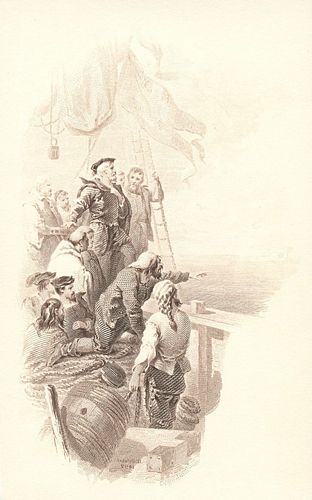
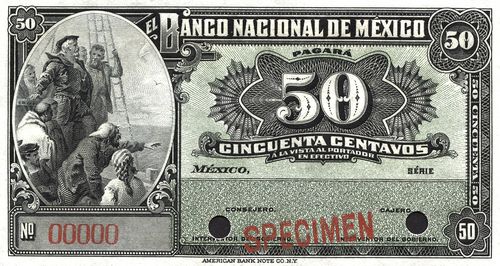
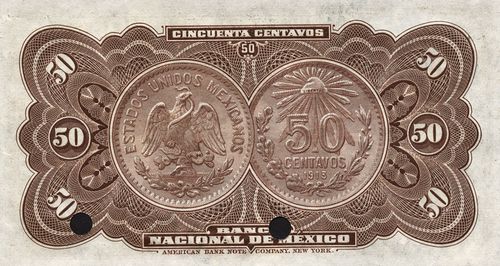 M295s 50c Banco Nacional de México specimen
| Date | Value | Series | from | to | |
| May 1914 | 50c | 2,000,000 | 000001 | 2000000 |
These 50c notes were dispatched in july and August. On 23 July the ABNC sent, per S.S. “Monterey”, 140,000 notes (000001-140000); on 6 August, per S.S. “Esperanza”, 280,000 (1400001-420000); on 13 August, per S.S. “Morro Castle”, 560,000 (420001-980000); on 20 August, on the “Monterey”, 420,000 (980001-1400000); and on 27 August, it completed the order with 600,000 (1400001-2000000).
On the 13 August order the Veracruz branch had to pay a fine of $352.00. The branch later explained “We inform you that we have sent one of our employees to interview the Accountant of the Maritime Custom House of the Port, who informs us that it having been a fine issued during the American intervention, it was impossible for him to give any class of details, as the invading troops took with them all the archives relating to their administration, having added that not even many more matters before the American intervention it possible to furnish information, as the American soldiers burnt all the papers which they found in the desks of the public offices of the Port when they occupied this place in April of the past year”.
On 18 March the bank ordered another 300,000 $10 (3870001-4170000), 200,000 $20 (1185001-1385000) and 100,000 $50 (502001-602000).
| Date | Value | Series | from | to | |
| March 1914 | $10 | 300,000 | 3870001 | 4170000 | |
| $20 | 200,000 | 1185001 | 1385000 | ||
| $50 | 100,000 | 502001 | 602000 |
However, this issue, together with the final batch of $100 notes (088001-100000) were never sent and remained in the ABNC’s vaults, though the ABNC regularly raised the subject. Thus, on 1 November 1927 the bank asked the ABNC to continue to hold them until further notice. The ABNC raised the matter again on 23 May 1927 and on 26 August was told to hold them a little longer, On 9 March 1926, and on 6 December 1929 the ABNC asked about them. The manager, A. Legorreta, told them that he had every reason to believe that the notes might be needed at some no very distant date, and asked the ABNC to continue warehousing the notes and on no account to destroy them. In response to a letter of 1 March 1939 on 23 July 1941 the Consejo de Administración of the Bank finally agreed to their incineration, though the bank asked for the original plates. “Now then, as regards the steel printing plates, we would thank you to deliver them to our Agency in your city, 52 William Street, to Mr.. John B. Glenn, Manager of our said Agency, and to that effect we are writing our said office this very day.”