Counterfeit $1 dos caritas
There were no counterfeit $1 dos caritas. Notes are known perforated (in batches) and overprinted 'FALSO' but these are genuine.
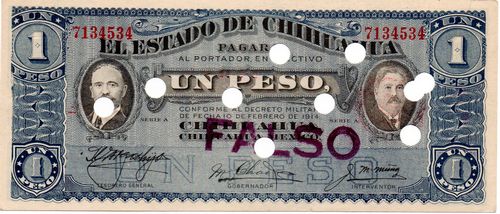
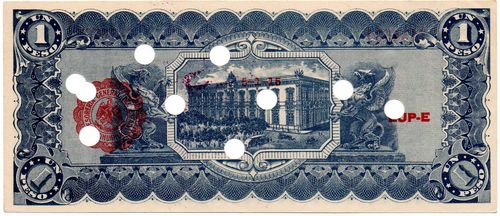
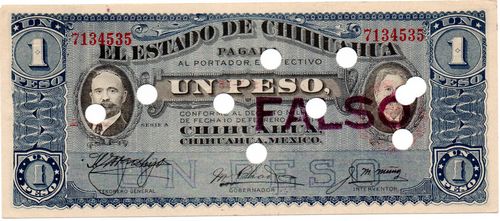
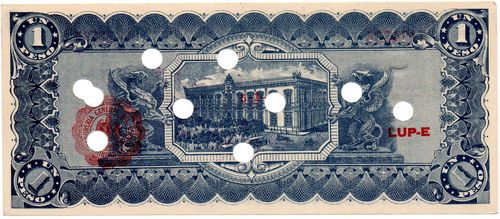 M920k $1 dos caritas o/p FALSO
These might have been connected with an incident in Cananea.
$1 dos caritas circulated profusely in Cananea but in April 1915 some $1 notes that had been restamped FALSO by the Inspector of paper currency in Nogales began to arrive and caused alarm, though the Prefecto Interino, Francisco Zepeda, decided that the notes were actually genuine. As no expert had yet arrived, on 10 and 11 April Zepeda wired Maytorena for permission to send someone to Chihuahua with the notes to consult the Tesorería del Estado about the matter. On 13 April Maytorena’s Secretario Particular and Jefe del Estado Mayor, Coronel R. de la Vega, replied that because it had been confirmed that there were no false $1 dos caritas and in order to avoid serious harm to poor people, $1 notes would continue not to be subject to revalidation and were of forced circulation. Zepeda relayed this to the public and reiterated Villa’s decree and Maytorena’s decree establishing the death penalty for counterfeiters. All this was worthy of a special edition of the Voz de Cananea which includes copies of the telegrams and decreesExtra for La Voz de Cananea, 14 April 1915.
Meanwhile, on 12 April, Charles L. Montague, the Acting American Consular Agent, reported that Prefect Zepeda has issued orders to permit no automobile to leave Cananea claiming that Americans who have been travelling back and forth between Cananea and Naco have been conveying information to Carranza representatives and also that they have been introducing counterfeit money into Cananea (which Montague believed to be untrue). That day Zepeda told Montague that he would execute any American caught with counterfeit money in their possession without permitting them a trial or any opportunity to defend themselves. “Such action would be very unjust as fiat money pronounced good and acceptance enforced one day is declared counterfeit following day. One case came to my personal attention when on April eighth official tax collector of Cananea paid American eighty-four one peso bills and on April tenth refused to accept same bills claiming that they were counterfeit and refusing redeem them with bills called good under pretence that they were good when he paid them to American.”
Montague added that as Zepeda was intoxicated a large part of time and as most of the generals and officers are drunk nearly every time they visited Cananea and as it is practically impossible to distinguish good bills from so-called counterfeits, he was afraid that Zepeda, when drunk, may carry out his threat to execute Americans. He suggested that Villa ne asked to replace with with a “sober, conscientious man”SD papers, 812.5157/77. On 16 April the State Department’s Special Agent, George Carothers, wired that Villa had promised to remove Zepeda and to permit the dispatch of telegrams without delaySD papers, 812.63.58.
It is not certain that the 84 $1 notes to which Montague referred were dos caritas. They are more likely to have been Monclova or Estado de Sonora notes.