El Banco de la Prosperidad, El Banco Nacional de la Felicidad and El Banco de la Felicidad
Three notes that are not paper currency but included in an attempt towards completeness,
El Banco de la Prosperidad
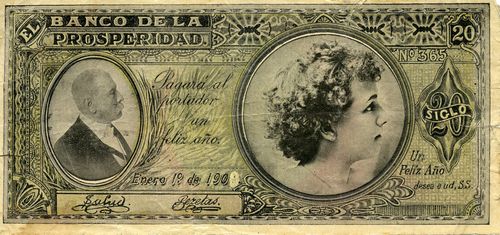
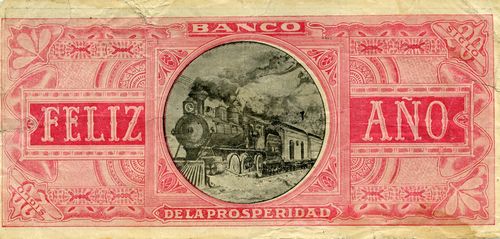 M697.5 Banco de la Prosperidad
[Until we can discover the provenance of this note, it is assigned to the Distrito Federal].
This note, from the Banco de la Prosperidad, wishes the bearer a Happy New Year for the new century. It is dated 1 January 1901, the denomination is SIGLO 20, and the number 365 (days). The signatories are Salud (Health) and [ ].
El Banco Nacional de la Felicidad
On 19 December 1910 Eudaldo Soler applied to the Secretaría de Instrucción Pública y Bellas Artes for the copyright of a flyer in the likeness of a banknote. According to the samples attached, the flyer was for $1,000 from the Banco de la Felicidad Nacional de MéxicoDiario Oficial, Tomo CXII, Núm. 10, 12 January 1911.
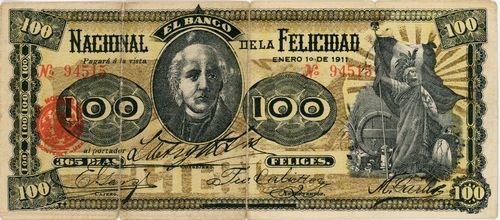
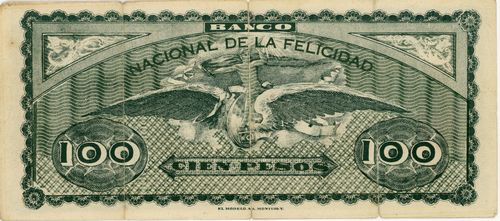
In fact, the resulting note had the number ‘100’ in each of its four corners, and in the centre the legend: "“El Banco Nacional de la Felicidad” Enero 1º de 1911. Núm. [94518] – Al portador – 365 días felices”Periódico Oficial del Estado de Coahuila, 25 November 1911. A latter description states that each note was finely lithographed, and that the figures “100” and the words “Un cien pesos” appeared conspicuously on its face but on closer examination each was seen to bear the legend: “El Banco Nacional de Felicidad pagara tres cientos sesenta y cinco días de felicia.”The Mexican Herald, 20th Year, No. 6999, 5 November 1914.
These notes were occasionally misused.
In 1911, in Torreón, Coahuila, three young bakers, Eleuterio Torres, Alvaro Aguirre and Victoriano Garza, were arrested for passing counterfeit banknotes. Torres, having found a purse with a note in it, entered Angela Martel's canteen and asked the bartender, if the note was good, to sell him a bottle of beer. Torres threw a folded note on the counter in payment but the cashier, Salvador Mora, saw that the note was no good and showed it to the landlady, who went to call a policeman to arrest Torres.
Aguirre and Garza had merely tried to cover Torres’ debt to resolve the situation and so were released, but on 27 June 1911 Torres was sent to prison (for a day and a half) for attempted robbery. However, on review, a judge found that that theft had not been proved, and Torres was ordered released Periódico Oficial del Estado de Coahuila, 25 November 1911.
In October 1911 Eduardo N. Flores, an auditor on the train that ran from Torreón to Lagos, was accused by Andrés Machaen of fraud. He had exchanged four legal $50 pesos for two of these $100 Banco Nacional de la Felicidad notes. Machaen was not happy and reported the fraud. Flores was apprehended in Aguascalientes in the La Crisantema boarding house, put in jail, tried and found guilty. However, since the crime was carried out in Zacatecas, the 1st Criminal Judge ordered him to be sent to that state to serve his prison sentence. Flores filed an appeal before the Supreme Court of Justice of Aguascalientes, but was told that jurisdiction lay directly in ZacatecasAHEA, Fondo Supremo Tribunal de Justicia. exp. .
In May 1913 some of these notes appeared in San AntonioSD papers, 812.5158/15 letter Acting Secretary of the Treasury to Secretary of State, 3 May 1913.
Someone unacquainted with the Spanish language would be more likely to accept such a note as worth one hundred Mexican dollars and in November 1914 it was reported in the San Antonio Light that they were being passed in Galveston, Texas. “The maker of such “currency” could hardly be convicted of counterfeiting, for in perfectly plain Spanish the holder is promised merely three hundred and sixty-five days of happiness. Of course the charge of obtaining money under false pretenses might be proved against one who successfully circulated the bills. If he attempted to circulate them, and failed, he might take refuge behind the plausible plea that he was “only fooling.”The Mexican Herald, 20th Year, No. 6999, 5 November 1914.
El Banco de la Felicidad
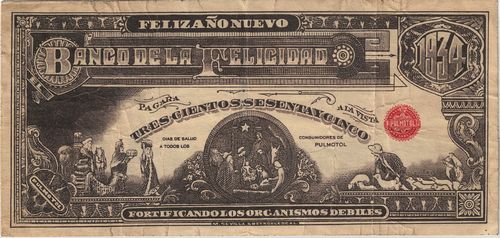 M4292.5 Banco de la Felicidad
Another note wishing a Happy New Year, this time in 1934 to users of Pulmotol, an anti-asthmatic remedy.