American Bank Note Company print runs
The vignettes used are discussed here.
The original 25c, 50c, $1 and $10 face, back and tint plates were engraved on 24 July 1888ABNC, folder 155, Banco Minero (1903(Dec)-1908(May).
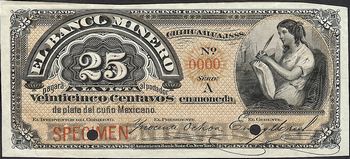
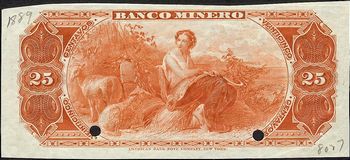 M128s 25c Banco Minero specimen
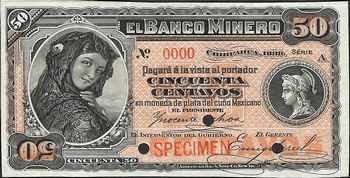
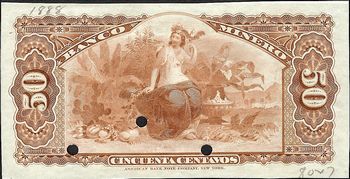 M129s 50c Banco Minero specimen
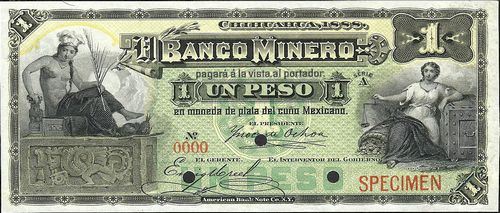
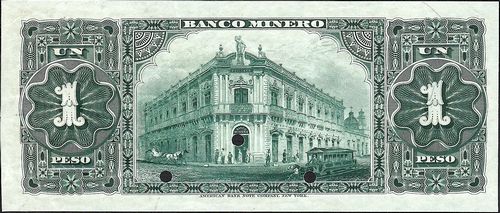 M130s $1 Banco Minero specimen
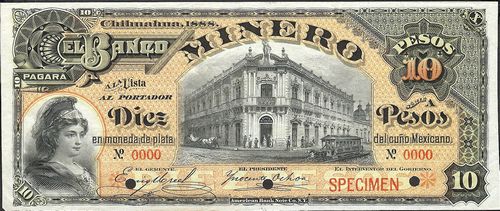
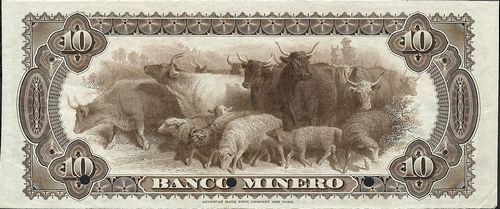 M133s $10 Banco Minero specimen
| Date | Value | Number | Series | from | to |
| July 1888 | 25c | 200,000 |
A | 00001 | 200000 |
| 50c | 200,000 |
A | 00001 | 200000 | |
| $1 | 100,000 | A | 000001 | 100000 | |
| $10 | 10,000 | A | 00001 | 10000 |
The original $5, $20, $50 and $100 face, back and tint plates were engraved in August 1888.
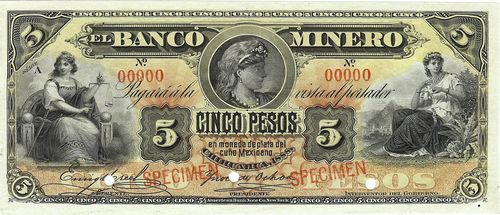
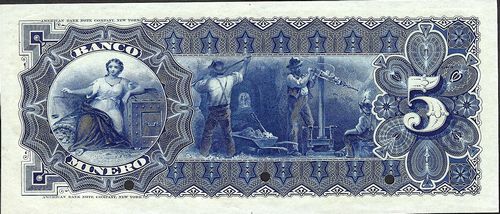 M133s $5 Banco Minero specimen
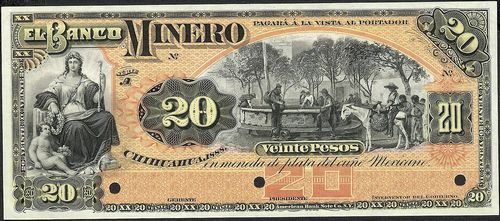
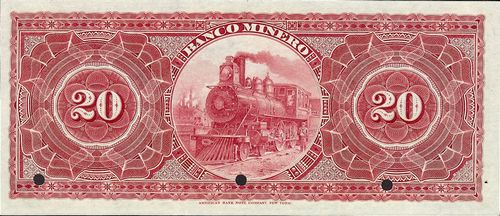 M135s $20 Banco Minero specimen
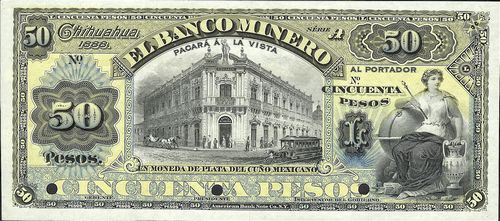
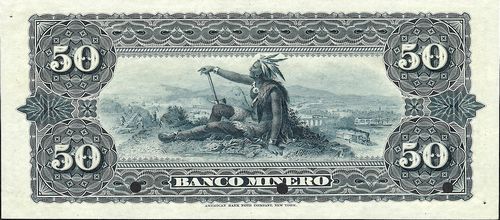 M136s $50 Banco Minero specimen
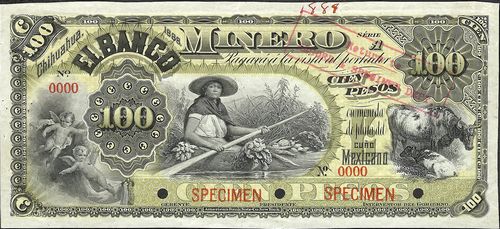
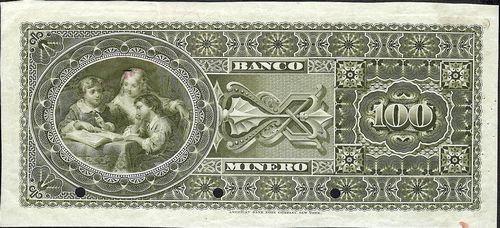 M137s $100 Banco Minero specimen
| Date | Value | Number | Series | from | to |
| August 1888 | $5 | 10,000 |
A | 00001 | 10000 |
| $20 | 5,000 |
A | 0001 | 5000 | |
| $50 | 2,000 | A | 0001 | 2000 | |
| $100 | 1,000 | A | 0001 | 1000 |
In July 1889 the face plates of the 25c and $1 notes were changed to Series B.
| Date | Value | Number | Series | from | to |
| July 1889 | 25c | 100,000 |
B | 00001 | 100000 |
| $1 | 100,000 | B | 00001 | 100000 |
| Date | Value | Number | Series | from | to |
| February 1894 | $5 | 20,000 |
10001 | 30000 |
In November 1894 the date and series of the $1 face plate were changed.
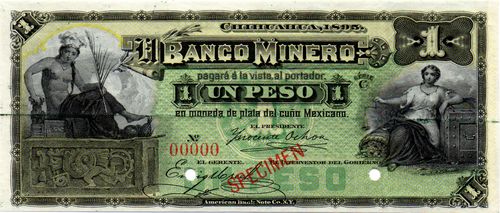 M130s $1 Banco Minero specimen
| Date | Value | Number | Series | from | to |
| November 1894 | $1 | 100,000 |
C | 000001 | 100000 |
In October 1895 the date on the $5 plate was changed from 1888 to 1896.
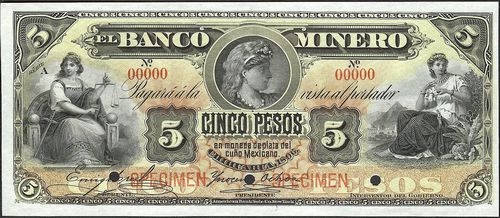 M131s $5 Banco Minero specimen
| Date | Value | Number | Series | from | to |
| October 1895 | $5 | 20,000 |
30001 | 50000 |
On 15 February 1897 the dates and series of the $5, $10 and $100 plates were changed.
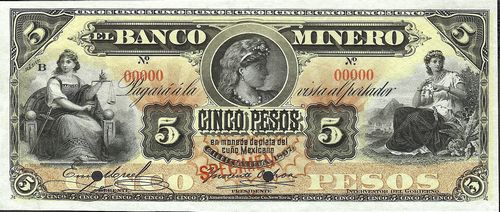 M131s $5 Banco Minero specimen
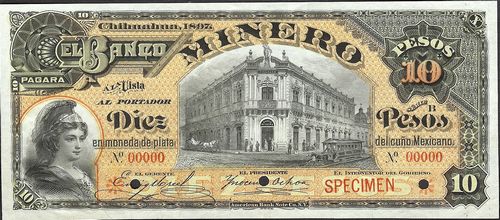 M133s $10 Banco Minero specimen
| Date | Value | Number | Series | from | to |
| February 1897 | $5 | 20,000 |
B | 00001 | 20000 |
| $10 | 10,000 |
B | 00001 | 10000 | |
| $100 | 1,000 | B | 0001 | 1000 |
In October 1897 the date and series on the $5, $10, $20, $50 amd $100 face plates were changed and the text changed to "pagará a la vista al portador a la par en efectivo".
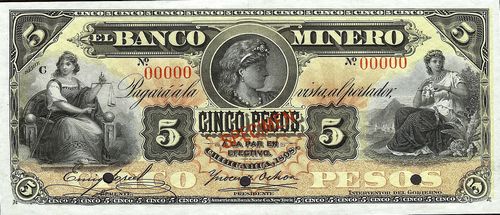 M131s $5 Banco Minero specimen
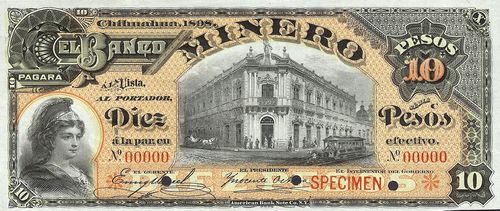 M133s $10 Banco Minero specimen
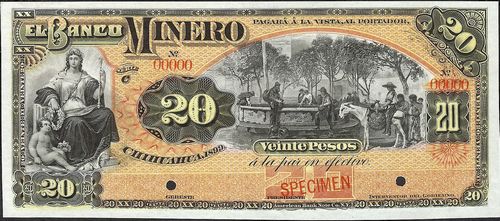 M135s $20 Banco Minero specimen
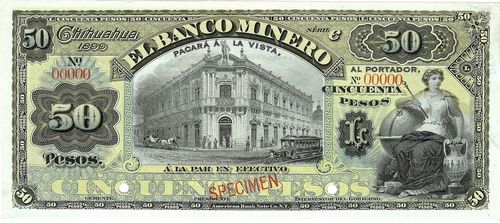 M136s $50 Banco Minero specimen
| Date | Value | Number | Series | from | to |
| October 1897 | $5 | 40,000 |
C | 00001 | 40000 |
| $10 | 15,000 |
C | 00001 | 15000 | |
| $20 | 2,500 | B | 0001 | 2500 | |
| $50 | 1,000 | B | 0001 | 1000 | |
| $100 | 5,000 | C | 001 |
Again the series and date were altered for September and October 1898 printings.
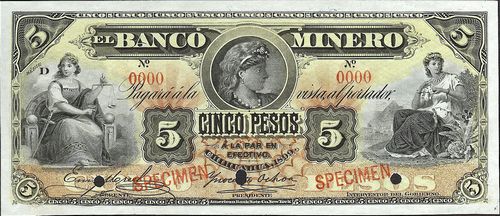 M131s $5 Banco Minero specimen
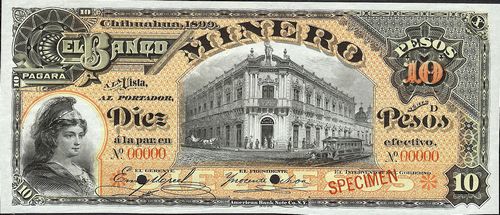 M133s $10 Banco Minero specimen
| Date | Value | Number | Series | from | to |
| September 1898 | $5 | 100,000 | D | 00001 | 100000 |
| October 1898 | $10 | 15,000 |
D | 00001 | 15000 |
| $20 | 2,500 | C | 0001 | 2500 | |
| $50 | 2,000 | C | 0001 | 2000 | |
| $100 | 2,000 | D | 0001 | 2000 |
In March 1901 a new $5 plate was engraved, leaving the series blank. The $50 and $100 plates were altered to 1901, with new series.
| Date | Value | Number | Series | from | to |
| March 1901 | $5 | 60,000 |
00001 | 60000 | |
| $50 | 2,000 | D | 0001 | 2000 | |
| $100 | 1,000 | E | 0001 | 1000 |
In February 1902, with order F12, the ABNC produced a $1,000 note with vignette C 996 on the reverse. The $5 face plates was changed with two notes with the date 1902, two with 1903 and two with 1904. The $10 and $100 face plates had the series erased and the date changed.
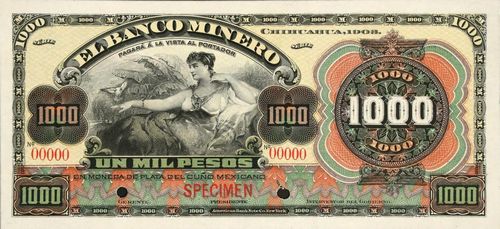
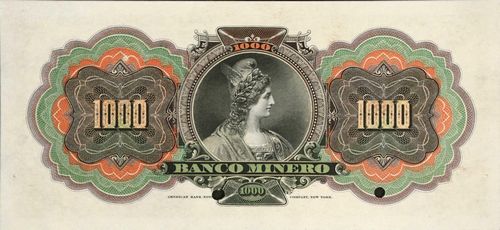 M138s $1,000 Banco Minero specimen
| Date | Value | Number | Series | from | to |
| February 1902 | $5 | 60,000 |
00001 | 60000 | |
| $10 | 10,000 |
00001 | 10000 | ||
| $100 | 3,000 | 0001 | 3000 | ||
| $1,000 | 1,000 | 0001 | 1000 |
In December 1902 four of the dates on the $5 plate were changed so all six read 1903. The date was changed and the series erased on the $20 and $50 peso plates (F147).
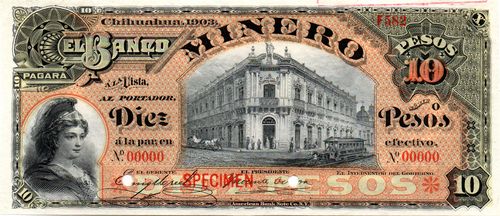 M133s $10 Banco Minero specimen
M136s $50 Banco Minero specimen
| Date | Value | Number | Series | from | to |
| December 1902 | $5 | 70,000 |
00001 | 70000 | |
| $10 | 15,000 |
00001 | 15000 | ||
| $20 | 5,000 | 0001 | 5000 | ||
| $50 | 3,000 | 0001 | 3000 | ||
| $100 | 2,500 | 0001 | 2500 |
On 12 September 1903 the bank ordered another $500,000 in $5 notes, “anxious to place these bills in circulation as soon as possible”. The dates on the $5 face plate were changed to 1904 (F310).
| Date | Value | Number | Series | from | to |
| December 1903 | $5 | 100,000 |
70001 | 170000 |
30,000 notes (O 70001-75000, P 75001-80000, Q 80001-85000, R 85001-90000, S 90001-95000, T 95001-100000) were received, via Wells Fargo & Co., on 20 January 1904, and 70,000 (U 100001-105000, V 105001-110000, W 110001-115000, X 115001-120000, Y 120001-125000, Z 125001-130000, A2 130001-135000, B2 135001-140000, C2 140001-145000, D2 145001-150000, E2 150001-155000, F2 155001-160000, G2 160001-165000, H2 165001-170000) on 19 February 1904ABNC, folder 155, Banco Minero (1903(Dec)-1908(May).
On 21 September 1905 the bank ordered 60,000 $5 and 20,000 $10 notes, replacing Enrique Creel’s signature with that of Juan A, Creel, the new manager, whose facsimile signature they finally sent on 30 October. The date was changed to 1906 (F685).
| Date | Value | Number | Series | from | to |
| September 1905 | $5 | 60,000 |
170001 | 230000 | |
| $10 | 20,000 |
15001 | 35000 |
All these notes, $5 (I2 170001-175000, J2 175001-180000, K2 180001-185000, L2 185001-190000, M2 190001-195000, N2 195001-200000, O2 200001-205000, P2 205001-210000, Q2 210001-215000, R2 215001-220000, S2 220001-225000, T2 225001-230000) and $10 (P 15001-16000, Q 16001-17000, R 17001-18000, S 18001-19000, T 19001-20000, U 20001-21000, V 21001-22000, W 22001-23000, X 23001-24000, Y 24001-25000, Z 25001-26000, A2 26001-27000, B2 27001-28000, C2 28001-29000, D2 29001-30000, E2 30001-31000, F2 31001-32000, G2 32001-33000, H2 33001-34000, I2 34001-35000) were forwarded, by Wells Fargo, on 12 December.
On 20 November 1906 the bank ordered another 50,000 $5 notes. The date on the $5 plate was changed to 1907 and the word "Serie" inserted on the right (F1030).
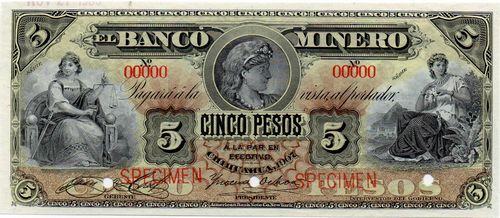 M131s $5 Banco Minero specimen
| Date | Value | Number | Series | from | to |
| November 1906 | $5 | 50,000 |
230001 | 280000 |
15,000 (U2 230001-235000, V2 235001-240000, W2 240001-245000) were sent on 16 March 1907 and the remaining 35,000 (X2 245001-250000, Y2 250001-255000, Z2 255001-260000, A3 260001-265000, B3 265001-270000, C3 270001-275000, D3 275001-280000) on 27 March.
On 6 November 1907 the bank ordered 50,000 $5 and 25,000 $10 notes. With this order (F1355) new plates were engraved for the $5 and $10, leaving off the date and Ochoa's signature.
| Date | Value | Number | Series | from | to |
| November 1907 | $5 | 50,000 |
280001 | 330000 | |
| $10 | 25,000 |
35001 | 60000 |
On 4 April 1908 the ABNC forwarded two boxes, box No. 1 containing 50,000 $5 notes (E-3 to N-3, Nos. 280001-330000) and No. 2 containing 25,000 $10 (J-2 to Z-2 and A-3 to H-3. Nos. 35001-60000).
On 3 March 1908, two days after the 1908 robbery in which one hundred $1,000 notes were taken, the bank asked the American Bank Note Company to prepare a new design (order F1534)ABNC, letter, Juan A. Creel to ABNC, 3 March 1908. On 23 March the ABNC sent two models for the face and back of the noteABNC, letter 23 March 1908.
The bank approved the multicolour model with a few amendments to the face and asking that instead of the vignette of three miners on the reverse there be a vignette of their new head offices, based on an engraving they enclosed.
They even specified the numbering and contraseñasABNC, letter, Juan A. Creel to ABNC, 30 March 1908. The specification was:
Numbers: Serie: Countermarks:
1 - 40 A. M. K. 125
41 - 80 B. W. N. 301
81 - 120 C. X. J. 376
121 - 160 D. A. D. 408
161 - 200 E. B. C. 177
201 - 240 F. D. X. 233
241 - 280 G. E. F. 392
281 - 320 H. H. L. 222
321 - 360 I. J. O. 575
361 - 400 J. K. M. 636
401 - 440 K. C. Z. 774
441 - 480 L. F. W. 288
481 - 520 M. V. W. 812
521 - 560 N. G. D. 555
561 - 600 O. Y. A. 583
601 - 640 P. H. B. 390
641 - 680 Q. X. E. 322
681 - 720 R. I. W. 999
721 - 760 S. Z. F. 144
761 - 800 T. J. G. 915
801 - 840 U. U. H. 973
841 - 880 V. K. M. 197
881 - 920 X. R. L. 218
921 - 960 Y. A. B. 388
961 - 1000 Z. L. Z. 932. However, when the stolen $1,000 notes were returned, on 8 May the bank immediately wired the ABNC to tell them to stop work. In a letter the following day the bank explained that since they had recovered all the missing notes, the new design was not needed.
The bank had previously complained about the fading of the signatures on the $1,000 notes and in January 1909 wrote that, because this continued to be a problem, it was contemplating changing to the new designABNC, letter, Juan A. Creel to ABNC, 9 January 1909. In March the ABNC furnished an engraved face proof, in which they had arranged more space for the signatures by reducing the bracket under the vignettes, a proof of the counter where the value “1000 Pesos” was to be engraved, and a proof of the back counter, in the centre of which would appear the engraving of the buildingABNC, letter 12 March 1909. In September the bank was still toying with the idea of a new $1,000 note, but was also contemplating using the vignette of the building (for which they had paid) on other items such as letterheads, cheques, letters of credit or bank statementsABNC, letter Juan A. Creel to ABNC, 12 March 1909.
This face proof belongs to this abortive issue.
In one of his letters Juan Creel refers to $1,000 notes held in Chihuahua that were incinerated without any official authorisation. This must refer to the quartered notes that were returned by the robbers in 1908 or to an incineration in 1911 when the political situation was unstable.
On 21 September 1909 the bank ordered $100,000 in $20 notes, $100,000 in $50 notes, and $100,000 in $100.00 notes. In October the date 1903 was erased from the $20, $50 and $100 face plates, leaving the space blank (F2192).
| Date | Value | Number | Series | from | to |
| October 1909 | $20 | 5,000 |
5001 | 10000 | |
| $50 | 2,000 | 3001 | 5000 | ||
| $100 | 1,000 | 2501 | 3500 |
On 13 January 1910 the ABNC dispatched one case containing 5,000 $20 (F 5001-6000, G 6001-7000, H 7001-8000, I 8001-9000, J 9001-10000), 2,000 $50 (G 3001-3500, H 3501-4000, T 4001-4500, J 4501-5000) and 1,000 $100 (K 2501-2750, L 2751-3000, M 3001-3250, N 3251-3500). These were received on 18 January. On 21 February the company dispatched 32,000 $% (O3 330001-335000, P3 335001-340000, Q3 340001-345001, R3 345001-350000) and 10,000 $10 (I3 60001-61000, J3 61001-62000, K3 62001-63000, L3 63001-64000, M3 64001-65000, N3 65001-66000, O3 66001-67000, P3 67001-68000, Q3 68001-69000, R3 69001-70000).
In December 1909 the ABNC prepared six signature dies for Luis Terrazas and cancelled the dies of Inocente Ochoa (F2299).
| Date | Value | Number | Series | from | to |
| December 1909 | $5 | 20,000 |
330001 | 350000 | |
| $10 | 10,000 |
60001 | 70000 |
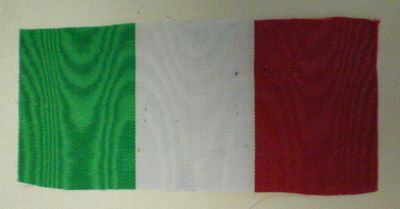 On 22 March 1910 the bank placed an order for $100,000 in $5.00 and $100,000 in $10.00 notesABNC letter, Juan A. Creel to ABNC, 22 March 1910. On 6 April they wrote to suspend the order, as they had decided to commemorate the first centennial of Mexican independence with a special issue. A memorandum specified that, if the ABNC had not already started printing, “it is our desire that the five and ten pesos notes which you are engraving at present, be made exactly as they are on the face, while on the back of the note to be divided in three equal parts, having the National colors: green, white and red, and in the middle of the back of the notes, or on the white space, which will be on the center, the engraving of Sun and Liberty Cap, such as used in the reverse of the Mexican silver peso, with the inscription on top of the circle reading “PRIMER CENTENARIO DE LA INDEPENDENCIA MEXICANA”, and on the same circle below the numbers “1910”. … As in our opinion the plain colors of green and red will not look well, you may place underneath each of them an interwoven, some kind of a back-ground, such as used in our $1,000.00 peso notes, without disturbing the effect of the said colorsABNC letter 6 April 1910”. On 20 April the ABNC sent models of the two backs, stating “If you so desire, we can print in the centre where the Cap of Liberty is shown, an underlying tint, which we could arrange to have made as light as possible, so as not to destroy the effect of the National colors. We would have liked to make up more artistic models than the ones we are sending you, but as the three colors have to be very distinct, they could not very well be arranged in a different manner"ABNC, letter 20 April 1910. The bank replied that the design was correct but the green and red colours were not satisfactory “inasmuch as they are not the National colors of México, specially the red which is more or less a sort of orange tint instead of red, and with the object of avoiding any misunderstanding, we are returning by registered mail the models and sample of the National colors of México, and it is our belief that you can very easily adopt them. The green is more or less what we want, but would like to have you match as near as possible to the sample, and unless you can supply the red as it is given on the sample, we would not care to have you proceed with the order, in which event please telegraph to us that we may given you further instructions”ABNC, telegram and letter bank to ABNC, 26 April 1910.
On 4 May the ABNC sent an exact proof of the colour on bank note paper that they proposed to use. “As you will note, we have improved very much on the green and red. This red is as near as we can come to the specimen sent us. Physically speaking, it is impossible for us to improve on the red, - the printing being done by lithography, and we trust that the same will be satisfactory to you”ABNC, letter, 4 May 1910. The bank approved, and the ABNC was able to ship the notes on 20 June, in time for the celebrations.
The order for this issue of $5 and $10 notes commemorating the centenary of Mexican independence was F2457.
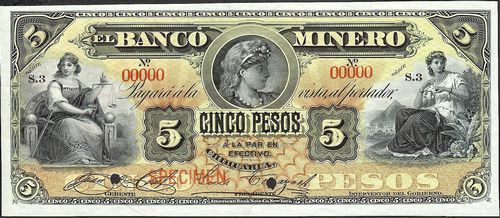
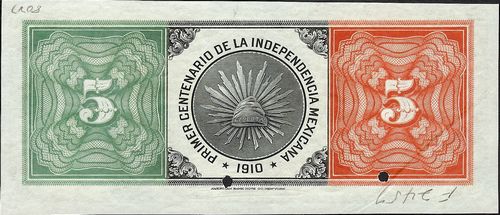 M132s $5 Banco Minero specimen
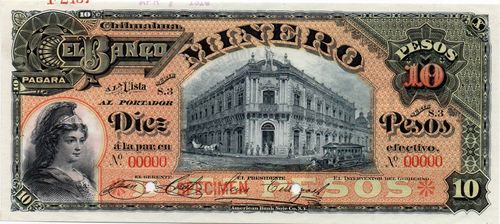
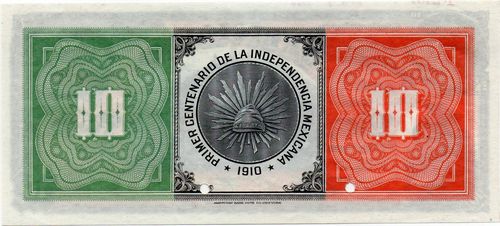 M134s $10 Banco Minero specimen
| Date | Value | Number | Series | from | to |
| April 1910 | $5 | 20,000 |
350001 | 370000 | |
| $10 | 10,000 | 70001 | 80000 |
On 21 June the ABNC sent one box containing the 20,000 $5 (35001-3700000) and 10,000 $10 notes (70001-80000).
On 20 September 1910 the bank ordered another 20,000 $5, 10,000 $10 and 5,000 $20 notes.
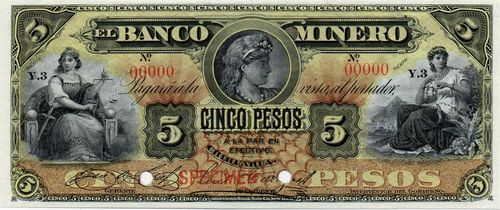 M131s $5 Banco Minero specimen
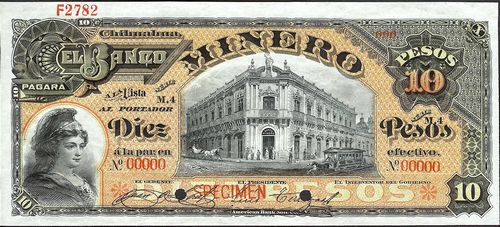 M133s $10 Banco Minero specimen
| Date | Value | Number | Series | from | to |
| October 1910 | $5 | 20,000 |
370001 | 390000 | |
| $10 | 10,000 |
80001 | 90000 | ||
| $20 | 5,000 | 10001 | 15000 |
The bank was in need of the $5 notes, so on 2 December the ABNC sent 5,000 $5 notes (W3 370001-375000). Then on 10 December it sent 15,000 $5 (X3 375001-380000, Y3 380001-385000, Z3 385001-390000), 2,000 $10 (C4 80001-810000, D4 810001-820000) and 2,000 $20 (K 10001-11000, L 10001-11000), received on 17 December. Finally. on 12 December it sent the remaining 8,000 $10 (82001-90000) and 3,000 $20 (12001-15000).
On 20 January 1911 the bank ordered 40,000 $5, 20,000 $10, 10,000 $20, 4,000 $50 and 2,000 $100 notes, being in need of notes to replace the ones they were withdrawing from circulation. As the notes had to be countersigned by the Secretaría de Hacienda y Crédito Público, in the City of Mexico, the bank asked for them to be sent to Messrs Creel Hermanos, Segunda de Capuchinas No. 43, México, D. F..
| Date | Value | Number | Series | from | to |
| January 1911 | $5 | 40,000 |
A4-H4 | 390001 | 430000 |
| $10 | 20,000 |
M4-Z4 A5-F5 |
90001 | 110000 | |
| $20 | 10,000 | P-Y | 15001 | 25000 | |
| $50 | 4,000 | K-R | 5001 | 9000 | |
| $100 | 2,000 | O-V | 3501 | 5500 |
On 21 March 1911 the ABNC sent the whole order, in two boxes, being 40,000 $5 (390001-430000), 20,000 $10 (90001-110000), 10,000 $20 (15001-25000), 4,000 $50 (5001-9000) and 2,000 $100 (3501-5500).
In November 1912 the ABNC prepared six electros of the signature of José María Aguirre Hernández to fit in the space for Interventor on the six values (F3485).
On 18 December 1912 the bank ordered 40,000 $5 (430001-470000) and 20,000 $10 notes (110001-130000).
| Date | Value | Number | Series | from | to |
| December 1912 | $5 | 40,000 |
I4-P4 | 430001 | 470000 |
| $10 | 20,000 |
C5-Z5 | 110001 | 130000 |
These were dispatched on 5 April 1913 to the Banco Central Mexicano in Mexico City. By this time there was no mail or railroad communication between Chihuahua City, Mexico City or the border so the Resident Agent strongly advised having this shipment traced and returned to New York to avoid the notes falling into the hands of the Revolutionists. On 9 May the box was located at the Wells Fargo & Co. Express office in Laredo. ABNC instructed Wells Fargo to hold it and wrote on 9 May and again on 6 August to the Banco Minero for instructions. The bank wrote on 16 October to ask about the shipment and the ABNC, on 3 November, replied that it was still in Laredo. The shipment was finally made, per the steamer “Morro Castle” via Veracruz on 3 December ($5 I4 430001-435000, J4 435001-440000, K4 444001-445000, L4 445001-450000, M4 450001-455000, N4 455001-460000, O4 460001-465000, P4 465001-470000: $10 G5 110001-111000, H5 111001-112000, I5 112001-113000, J5 113001-114000, K5 114001-115000, L5 115001-116000, M5 116001-117000, N5 117001-118000, O5 118001-119000, P5 119001-120000, Q5 120001-121000, R5 121001-122000, S5 122001-123000, T5 123001-124000, U5 124001-125000, V5 125001-126000. W5 126001-127000, X5 127001-128000, Y5 128001-129000, Z5 129001-130000).
On 28 November 1913 the bank ordered 200,000 $1 notes (A 00001-100000, B 100001-200000), to be exactly similar to the notes furnished in 1894, but with new signatures. So, in January 1913 the ABNC altered the original $1 plate by removing the date 1895, Series letter A and the signatures (F3985).
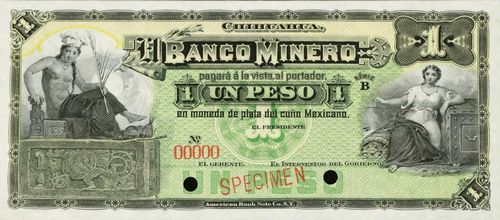 M130s $1 Banco Minero specimen
| Date | Value | Number | Series | from | to |
| November 1913 | $1 | 200,000 |
A | 000001 | 100000 |
| B | 100001 | 200000 |
On 10 January the bank asked for prices and delivery on 100,000 $1, 100,000 $2, 100,000 $5, 50,000 $10, 10,000 $20 and 5,000 $100 notes, with the $20 and $100 needed first, and then the $5 and $10 notes. The ABNC gave a price for $2 notes, but Enrique Creel decided not to issue that denomination, though he confirmed the rest of the order.
| Date | Value | Number | Series | from | to |
| January 1914 | $1 | 100,000 |
C | 200001 | 300000 |
| $5 | 100,000 |
Q4-Z4 A5-Z5 |
470001 | 570000 | |
| $10 | 50,000 | A6-Z6 A7-X7 |
130001 | 180000 | |
| $20 | 10,000 | A10-K10 | 25001 | 35000 | |
| $100 | 5,000 | A5-K5 | 5501 | 10500 |
On 21 January Blackmore wrote that Manuel Rivero Collada of the Banco Oriental de México had told him that he could tell Enrique Creel that he was contemplating issuing 50c notes, as in all probability both would work in unison and issue these fractional currency notes at the same time. So Creel had given authority to proceed with the preparation of a model for a fifty centavo note.
The same day the ABNC wrote to Blackmore “with reference to your telegram of the 19th, instructing us not to print in the signature of the Consejero, we find upon investigating that there is no such title on their One Peso Notes, and accordingly wired you to this effect, mentioning that there were three titles on the notes – namely: Presidente Gerente Intervenor del Gobierno. According to our order, we are to type in the signatures for all of these except the “Interventor del Gobierno”. We trust this is satisfactory, since we are shipping some of these notes on the steamer of the 22nd.
We are today in receipt of your telegram of Jan. 21st, instructing us not to print in the signature of “Luis Terrazas”, Presidente on your order of Nov. 28th for the One Peso Notes; but since our today’s shipment had all been finished, carrying this signature, we decided to let them go and telegraphed you to this effect, at the same time asking you how we were to print the balance of this denomination – with or without this signature, and anxiously await your reply.
Although your instructions were quite clear, we thought that perhaps since part of these notes bore this signature, the Bank would rather have them all alike.”
The same day Blackmore telegraphed “Do not Print in signature of LUIS TERRAZAS, PRESIDENTE THIS ONLY Applies to order November 28th” but the next day changed this to “you can continue printing signatures “LUIS TERRAZAS” ALL 1 Peso Bank Notes.”
On 22 January the ABNC sent, by Wells Fargo Express, per S. S. “Monterey”, via Veracruz, a box containing 10,000 $1 (A 000001-010000). On 26 January it was asked to make all future shipments care of Creel Hermanos, 2a Capuchinas 42, México City, México, instead of to the Banco Central Mexicano.
On 29 January the company forwarded, per the steamer “Morro Castle” to the Banco Central Mexicano, Mexico City, four boxes containing:190,000 $1 notes (A 010001-200000) and a box containing 3,000 $20 (A10 25001-26000, B10 26001-27000) and 3,500 $100 notes (A5 5501-6000, B5 6001-6500, C5 6501-7000, D5 7001-7500). On 5 February S. S. “Esperanza” carried 8,000 $20 notes (C10 27001-28000, D10 28001-29000, E10 29001-30000, F10 30001-31000, G10 31001-32000, H10 32001-33000, J10 33001-34000, K10 34001-35000) and 3,000 $100 (E5 7501-8000, F5 8001-8500, G5 8501-9000, H5 9001-9500, J5 9501-10000, K5 10001-10500).
On 10 February Blackmore pointed out that they had used Enrique Creel’s signature instead of Juan A, Creel’s on the $1 notes. Creel asked if there is not some way in which the wrong signature could be erased and the right signature printed in its place but Blackmore told him that this was impossible as the background of the note would suffer in the process.
The ABNC at first wondered whether Blackmore could not have persuaded. Creel to accept these notes as the difference in name was so slight and the need of the bank so urgent and “we would even have been prepared to make a large allowance ($1,000 US) in the price of these notes if Creel could have seen his way to accept them with the wrong signature. However, on thinking this matter over we came to the conclusion that you would certainly have tried this method with the bank and we therefore felt that Creel had very strong reasons for not wishing to accept these notes and accordingly cabled you as we did, stating that we would reprint at our expense. Work has been put in hand and you can rely on our shipping as soon as possible.
With regard to the 200,000 notes delivered, you, of course, know that we will have to have a duly authenticated certificate saying that they had been destroyed in the presence of the bank officials and yourself, as duly authorised representative of the company, before we can deliver the new notes, and presume that you are already attending to this for us.
As requested we will show no signatures on this reprint and will deliver the notes in sheets of 5, so that the signatures can be more easily printed on by the Bank.”
| Date | Value | Number | Series | from | to |
| February 1914 | $1 | 200,000 |
On 26 February the company sent, via S.S. “Morro Castle” 50,000 $1 (C 200001-250000), 100,000 $5 (A-U 470001-570000), 50,000 $10 (A-U, 130001-180000).
As for the suggestion of a 50c note, on 27 February the ABNC replied that “it thought it better to refrain from making this design until we know whether the Banco Oriental had been successful in securing permission to issue 50 centavos notes, because it seems to us that if they cannot obtain authority to issue notes of this small denomination neither will the Banco Minero be able to issue them.
If, after we have submitted the Oriental models, Mr. Collada finds that he can issue these notes, we will of course prepare the model for the Banco Minero. This is only an idea on our part which we thought would perhaps save our going to any unnecessary expense. However, if you think that Mr. Creel is expecting a model and would be annoyed if he did not receive one, we will of course make up a design. Please let us know what you think.”
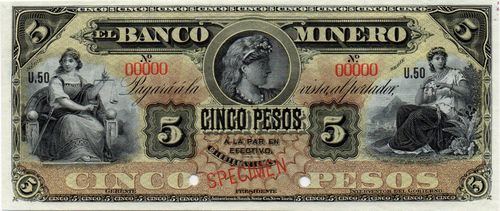 M131s $5 Banco Minero specimen
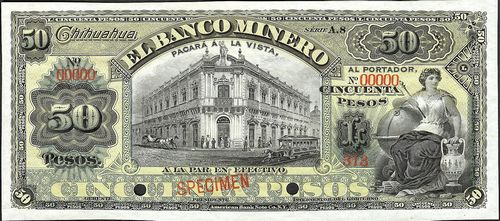 M136s $50 Banco Minero specimen
| Date | Value | Number | Series | from | to |
| March 1914 | $1 | 200,000 |
D | 300001 | 400000 |
| E | 400001 | 500000 | |||
| $5 | 100,000 | A51-U51 | 570001 | 670000 | |
| $10 | 50,000 |
A26-U26 | 180001 | 230000 | |
| $20 | 20,000 | A11-U11 | 35001 | 55000 | |
| $50 | 2,000 | A7-U7 | 9001 | 11000 | |
| $100 | 3,000 | L5-Z5 | 10501 | 13500 |
In March 1914 the American Bank Note Company printed another 1,500 $1,000 notes in the original design, but altering the face plate by taking out the year (F4138).
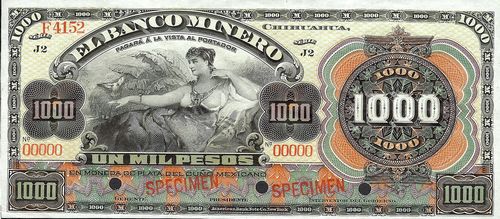
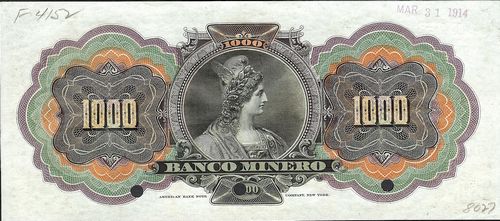 M138s $1,000 Banco Minero specimen
Though the $1,000 notes were shipped to Mexico, they spent six years in storage there before finally being incinerated. In May 1914 these notes were understood to be held in the Banco Central Mexicano, awaiting authorisationCEHM, Fondo Creel, 23566 and four hundred and fifty notes (1551 to 2000) were authorised by the Secretaría de Hacienda on 7 July 1914 but, because they were too large a denomination to circulate easily, on 1 August 1914 the Bank asked to change the authorisation to $450,000 in five and ten pesos notesCEHM, Fondo Creel, 22041, letter of Enrique C. Creel, 1 August 1914.
However, it seems that the notes never left the Wells Fargo office in Veracruz. In August 1917 Juan A. Creel was writing to Enrique Creel about arranging with that office to cancel and incinerate all the notes they were holdingCEHM, Fondo Creel, 49047, letter of Juan A. Creel, 6 August 1917, but as both Creels were out of the country it took years to come to fruition. Juan raised the subject again in January 1919CEHM, Fondo Creel, 56449, letter of Juan A. Creel, 20 January 1919, but Enrique hesitated because of the remote possibility that the Banco Minero might continue as a bank of issueCEHM, Fondo Creel, 56916, letter of Enrique C. Creel, 23 January 1919. However, by February they had agreed to pay Wells Fargo’s bill, and incinerate the notes. The 1,500 notes (numbered 1001-2500) were finally destroyed on 17 April 1920CEHM, Fondo Creel, 66473, letter of Juan A. Creel, 26 April 1920.
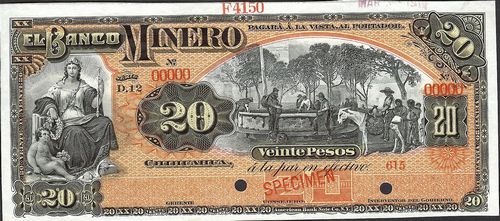 M135s $20 Banco Minero specimen
| Date | Value | Number | Series | from | to |
| March 1914 | $10 | 50,000 |
A27-U27 | 230001 | 280000 |
| $100 | 10,000 |
A6-U6 | 13501 | 23500 | |
| $1,000 | 1,000 | N1-V1 A2-H2 |
1001 | 2000 |
| Date | Value | Number | Series | from | to |
| March 1914 | $1 | 100,000 |
F1-F10 G1-G10 |
500001 | 600000 |
| $5 | 40,000 | A52-U52 | 670001 | 710000 | |
| $10 | 50,000 |
A28-U28 | 280001 | 330000 | |
| $20 | 10,000 | A12-U12 | 55001 | 65000 | |
| $50 | 10,000 | A8-U8 | 11001 | 21000 | |
| $100 | 10,000 | A7-U7 | 23501 | 33500 | |
| $1,000 | 500 | J2-Z2 A3-C3 |
2001 | 2500 |
On 5 March the S. S. “Esperanza” carried the final 50,000 $1 (C 250001-300000).
On 5 March the bank ordered another 200,000 $1, 100,000 $5, 50,000 $10, 20,000 $20, 2,000 $50 and 3,000 $100.
On 23 March the bank ordered 50,000 $10 (230001-280000) 10,000 $100 (13501-23500) and 1,000 $1,000 (1001-2000).
On 24 March Blackmore reported that he asked Creel if he intended issuing 50c notes and if he still wanted a model and was told that Creel would like to have a model as he expects soon to issue these notes. The next day the ABNC replied that, “upon looking this matter up we were surprised to discover that e had furnished this bank with 25 and 50 Centavos notes in the year 1888. We are enclosing herewith cancelled proofs of the face and back of the 50 Centavos note, which you can submit to them for their inspection. We like the appearance of these bills very much and hope that they will also please the bank, as we would prefer to use these old dies than have to prepare new designs and engravings. Also, we would point out that by using these old dies we can save considerable time in the execution of this order.
Of course, the bank may be fully aware that they originally issued notes of these denominations and may have very good reasons for wanting new designs, in which case we will naturally comply with their wishes, but we think it strange if this is the case, that Mr. Creel never mentioned anything about these old notes to you and Mr. Gibbs when the matter was originally taken up. … You will note on the proof we are sending you that the date appears and also the facsimile signatures which we printed on them at the time. Of course, this proof is from the plate as it now stands, but naturally, if we are successful in securing this order we will take the date out and will also show whatever signatures they desire.”
On 23 March 1914 the bank ordered 50,000 $10, 10,000 $100 and 1,000 $1,000 note. Three days later, Blackmore reported that the bank these notes as quickly as possible as they were making a loan to the government.
On 30 March the bank ordered 100,000 $1, 40,000 $5, 50,000 $10, 10,000 $20, 10,000 $50, 10,000 $100 and 500 $1,000 notes, asking the ABNC to make weekly shipments to Creel Hermanos in Veracruz. However, the ABNC had to lay down new $50 and $100 plates.
On 6 April Blackmore reported that Creel was going to study the proposition of issuing fractional currency, “as he tells me that unless the Government changes its terms allowing the banks to issue 50 centavo notes we will have little or no incentive to issue notes of this denomination, as it would mean a decided financial loss and be of no advantage to the Bank.
This is for the reason that the law demands that for every note issued, the Bank issuing, must have in its vaults as a guarantee a 50 centavo coin. In other words they must keep a guarantee deposit of 100 percent of the face value of the note issued.
Mr. Rivero Collada of the Banco Oriental de México is hoping the law governing the issue of 50 centavos notes will be changed. He therefore placed an order with us right away in order to have the notes ready to issue when the change is made. All the Banks are trying to get the law changed.”
On 9 April the ABNC forwarded, per the steamer “Mexico” two boxes, No. 15 containing 50,000 $1 (A 000001-050000) and No. 16 with 50,000 $1 (A 050001-100000) to replace the ones printed with the wrong signature. Also in box No. 16 were 1,000 $100 (L5 10501-10700, M5 10701-10900, N5 10901-11100, O5 11101-11300, P5 11301-11500). On 15 April it sent, per the steamer “Monterey” four boxes: No. 17 with 50,000 $1 (B 100001-150000), No. 18 with 50,000 $1 (B 150001-200000), 5,000 $20 (A11 35001-36000, B11 36001-37000, C11 37001-38000, D11 38001-39000, E11 39001-40000), 2,000 $100 (Q5 11501-11700, R5 11701-11900, S5 11901-12100, T5 12101-12300, U5 12301-12500, V5 12501-12700, W5 12701-12900, X5 12901-13100, Y5 13101-13300, Z5 13301-13500), No. 19 with 50,000 $1 (D 300001-350000), and No. 20 with 50,000 $1 (D 350001-400000).
On 23 May it sent three boxes per S.S. “Guantanamo”. Box No. 21 has 50,000 $1 (E 400001-450000) and box No. 22 50,000 $1 (E 450001-500000). Box No. 23 has 15,000 $20 F11-H11, J11-U11, 40001-55000), 2,000 $50 (A7-H7, J7-U7, 9001-11000) and 1,500 $1,000 (M2-J2, Z2, A3-O3 1001-2500).
On 13 June it sent four boxes on the steamer “Kotonia”. Box No. 24 had 50,000 $1 (500001-550000), box No. 25 50,000 $1 (550001-600000), box No. 26 50,000 $5 (570001-620000) and box No. 27 50,000 $10 (180001-23000) and 10,000 $20 (55001-65000).
On 9 July the ABNC sent, per the steamer “Guantanamo” 50,000 $5 (620001-670000) and 50,000 $10 (230001-280000). On 23 July the company sent, per S.S. “Monterey” 40,000 $5 (670001-710000) and 50,000 $10 (280001-330000). On 6 August the ABNC shipped, per S.S. “Esperanza” 10,000 $50 (11001-21000) and 4,000 $100 (13501-17500) and on 13 August it sent, via S.S. “Morro Castle” 16,000 $100 (17501-33500).
In August 1931 the Comité Liquidador de los Antiguos Bancos de Emisión gave the ABNC authorisation to destroy the remaining plates and these were cancelled on 13 April 1932The plates were:
1 – 21 25c face plate
1 – 21 25c back plate
1 – 1 25c tint plate
1 – 18 50c face plate
1 – 18 50c back plate
1 – 1 50c tint plate, all made on order of 24 July 1888
2 – 10 $1 face plates Nos. 2 & 3 made on order 19 November 1894
2 – 10 $1 face plates Nos. A8-A9 made on order F 4148
2 – 10 $1 back plates Nos. A7-A8 made on order F 4087
2 – 1 $1 tint plates Nos. 1 & 2 made on order 24 July 1888
1 – 6 $5 face plate #9 made on order F 3526
1 – 6 $5 face plate #10 made on order F 4106
1 – 6 $5 back plate #8 made on order F 1355
1 – 6 $5 Centennial back plate made on order F 2457
2 – 1 $5 tint plates Nos. 1 & 2 made on order 3 August 1888
1 – 6 $10 face plate #6 made on order F 4106
1 – 6 $10 back plate #4 made on order F 3526
1 – 6 $10 Centennial back plate made on order F 2457
2 – 1 $10 tint plates Nos. 1 & 2 made on order 24 July 1888
1 – 2 $20 face plate #2 made on order F 2265
1 – 2 $20 back plate #3 made on order F 4107
2 – 1 $20 tint plates Nos. 1 & 2 made on order 3 August 1888
1 – 4 $50 face plate made on order F 4151
1 – 4 $50 back plate made on order F 4151
2 – 1 $50 tint plates Nos. 1 & 2 made on order 3 August 1888
1 – 4 $100 face plate made on order F 4138
1 – 4 $100 back plate made on order F 4138
2 – 1 $100 tint plates made on order 3 August 1888
1 – 1 $1,000 face plate made on order # 12
1 – 1 $1,000 back plate made on order # 12
1 – 1 $1,000 face plate
1 – 1 $1,000 back plate
1 – 1 $1,000 tint plate, all made on order F1534.