Commercial concerns (central Michoacán)
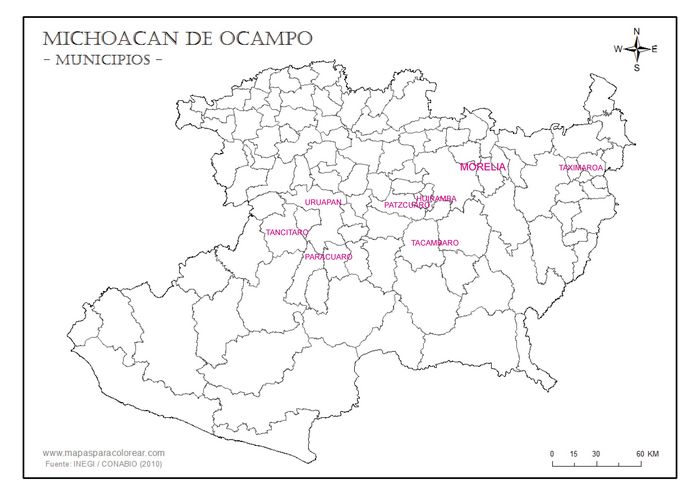
Huetamo
In March 1914 because of the lack of small change local businesses resorted to a series of typewritten notes, on paper of different colours, for 5c, 25c, 50c and $1, with the stamp of three of the principal casas comerciales. These were reissued every fortnightEl Diario, 6 March 1914.
Pátzcuaro
La Bahia de Veracruz
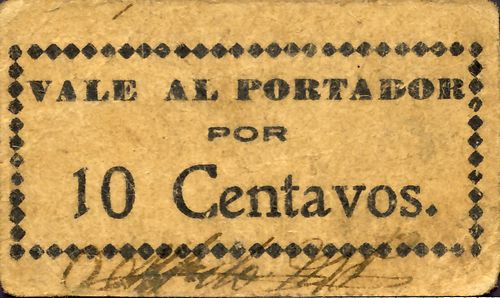
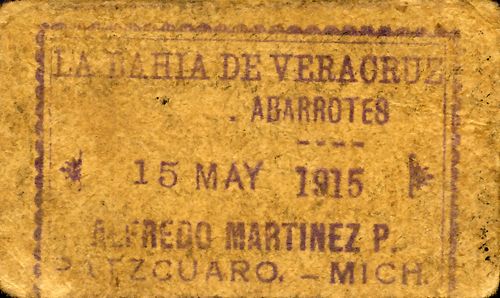 M3028 10c La Bahia de Veracruz
This grocery, run by Alfredo Martínez P., issued notes in May 1915.
La Casa Buitron
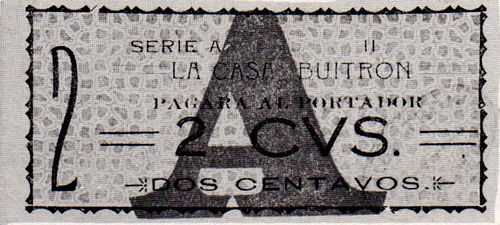 M3030 2c La Casa Buitron.
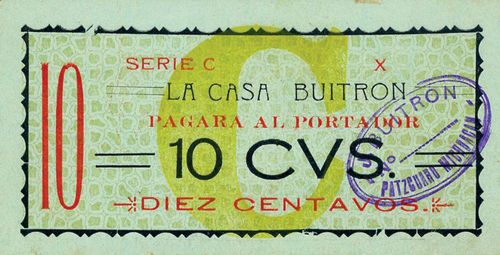 M3031 10c La Casa Buitron
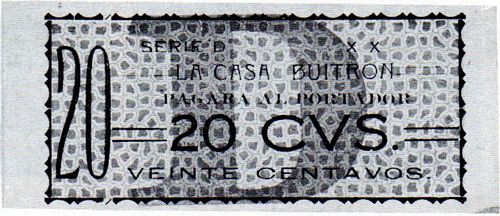 M3032 20c La Casa Buitron
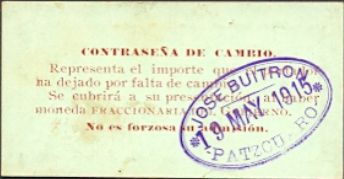
reverse of M3033 50c La Casa Buitron
| series | date on note | from | to | total number |
total value |
||
| 2c | A | 30 May 1915 | |||||
| 5c | B | ||||||
| 10c | C | ||||||
| 20c | D | 30 May 1915 | |||||
| 50c | E | 19 May 1915 |
La Casa Buitron appears to have been a hardware store (ferretería) in the calle Zaragoza, run at some time by a señor Leal.
José Buitron had a printshop, tipografia J. Buitron, situated in the plaza principal, that as well as these notes (judging from their multicoloured appearance) also printed the notes for the Hacienda de Tepenahua y Anexas.
Huiramba
La Confianza
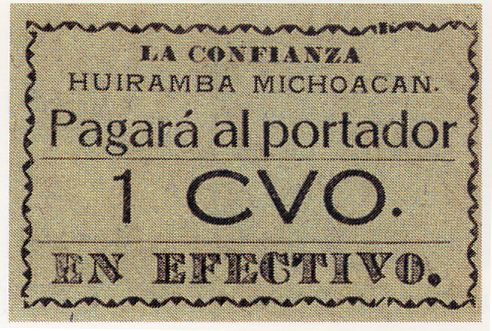 M2993 1c La Confianza
Cayetano Gutiérrez ran "La Confianza".
Taximaroa/Villa Hidalgo
Before 1908, what is now Ciudad Hidalgo was known as Taximaroa, a name of Purépecha origin meaning “place of carpenters.” In 1908, it was renamed Villa Hidalgo in honor of Miguel Hidalgo, and by 1921, having gained city status and serving as the head of the fiscal and judicial district, it was officially named Ciudad Hidalgo.
The change in name of the city is very important to point out because some stamps on the notes have the name of the town as TAXIMAROA and others VILLA HIDALGO. This happened because at least one of the individuals (Víctor Barajas) used his previous sealing machine and did not change it for a new one after the city was renamed. The following notes, as the ones from La Virgen, were also printed by “Tipografía Melchor Ocampo”.
Victor Barajas
The brothers Víctor and Lamberto Barajas were among the city’s merchants who also manufactured notes. In 1903 Victor Barajas is listed in charge of a wholesale grocery store (almacén de abarrotes nacionales y extranjeros). He served as a regidor in 1905. The brothers must have issued notes in the denominations of 1, 2, 5, 10, 20, and 50 centavos.
Series 1
This 1-centavo note has straight lines and the flower design in the four corners that we saw in the second series of “La Virgen.” We can also find this design in other merchants.
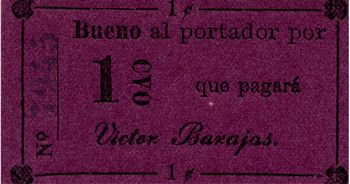
M3067 Victor Barajas 1c
Of the same design, within the group of notes were some 50-centavos printed on blue cardboard in two colours of black ink: a bright one that, due to age and deterioration, now appears copper-colored, and a completely black one, as in the case of the 1-centavo bill. This denomination had not been cataloged for this individual, and the existence of strips of these bills is certainly a discovery. All examples are numbered with the characteristic blue ink used by the printer.
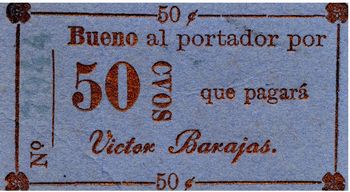
M3067.5 Victor Barajas 50c
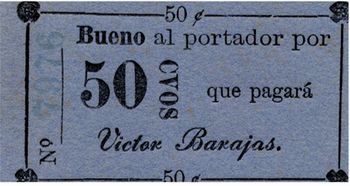
M3067.5 Victor Barajas 50c
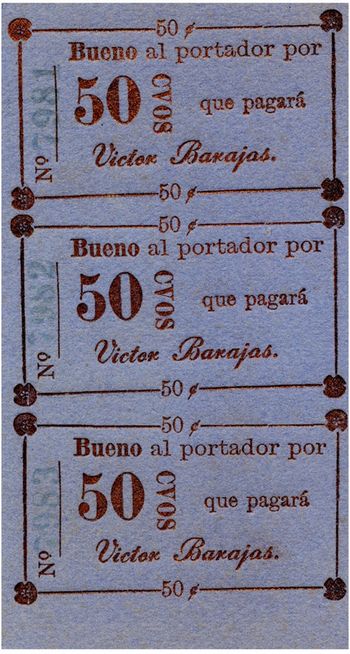
M3067.5 Victor Barajas 50c
| from | to | total number |
total value |
||
| 1c | includes number 7945 | ||||
| 2c | |||||
| 5c | |||||
| 10c | |||||
| 20c | |||||
| 50c | includes numbers 7944 to 7983 |
Series 2
Of Víctor Barajas’s 1-centavo notes, we can find these 1-centavo notes signed on the front and stamped on the back, with a signature on the front but no seal on the back, and unsigned on the front and no seal on the back. All were numbered in blue-green ink. It might appear, from the evidence, that they were printed on purple and brown cardstock; however, the ones in brown colour actually represents the discoloration of the purple from the sun and use.
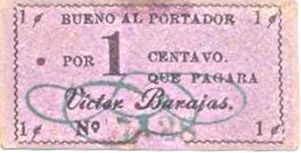
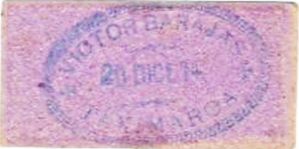 M3066a Victor Barajas 1c
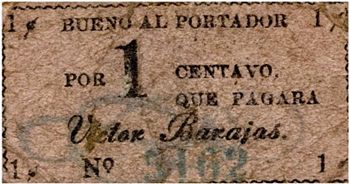
M3066a Victor Barajas 1c with signature
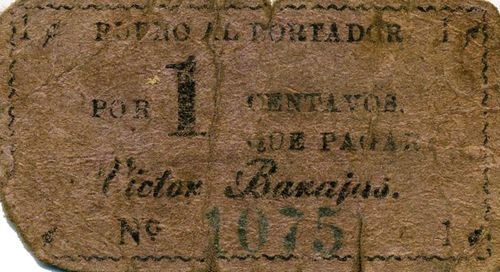 M3066a Victor Barajas 1c unsigned
The 1c note numbered 7427 is dated 20 December 1914.
| from | to | total number |
total value |
||
| 1c | includes numbers 1075CNBanxico #11584 to 7427 |
It would be very strange if only the smallest and largest denominations were printed: more denominations must have been printed for Víctor.
Lamberto Barajas
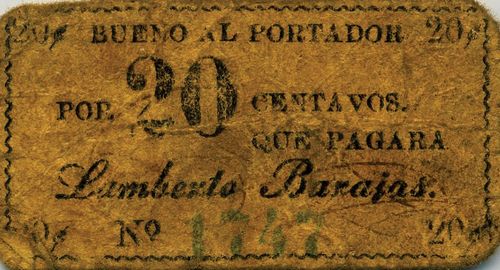
The 20c note numbered 1061 is dated 3 February 1915.
| from | to | total number |
total value |
||
| 20c | includes numbers 1061 to 1747CNBanxico #11585 |
Regarding Víctor’s brother, Lamberto, I only know of the existence of 20-centavos notes featuring a toothed frame design on yellow cardboard and a previous type with linear frame as the ones from his brother Víctor. I have knowledge of three examples of the zigzag type: one from Marco´s find, unstamped on the reverse, and another from the Banco de México Collection, formerly Coindreau, stamped on the reverse, and the one printed in the 2025 edition of Mexican Paper Money. Unlike his brother Víctor, Lamberto did stamp it with the correct city name, “Villa Hidalgo.”
20 centavos 3 February 1916 stamped 31 x 56 mm ( M3068a) Col Banco de México #11585
20 centavos - 38 x 67 mm (M3068a) Col. Ricardo Vargas
Máximo Martínez
Máximo was Mayor of Villa Hidalgo in 1911 and a great benefactor to the city, as he donated a large piece of land for the construction of a sports park that bears his name today. From Máximo Martínez, as with Víctor Barajas, there are two types of issues: the one with the zigzag frame and the one with a linear frame with flowers in the four corners.
Series 1
So far, I have only been able to locate copies with a value of 2-centavos. The first of them are printed in red cardboard, and exist hand-numbered, stamped on the back with the date 28 December 1914, and signed. The seal of Máximo Martínez does use the official name of the city at the time, Villa Hidalgo. As a signature, we can see a large “M” above the stamp.
Other examples are numbered with the blue-green ink characteristic of this printer, but without a seal or signature.
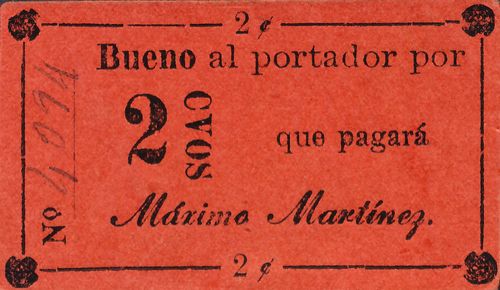
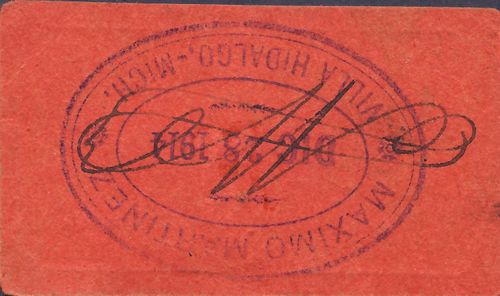 M3073a Máximo Martínez 2c
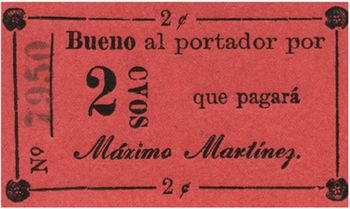 M3073a Máximo Martínez 2c
| from | to | total number |
total value |
||
| 2c | handwritten number includes number 4074 |
||||
| printed number includes number 7950 |
Series 2
The second “zigzag type” is printed on orange cardboard numbered in blue-green ink, signed and stamped on the back with the date 28 January 1915. As can be seen, at least in this case, the serrated margins are later than the margins with four flowers. This was possible to determine from the seals. Perhaps in the case of Víctor and Lamberto, this is also the case. However, due to the lack of evidence this cannot be determined with certainty.
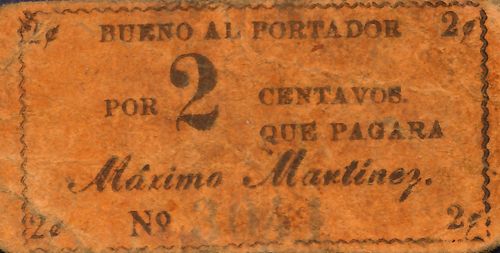
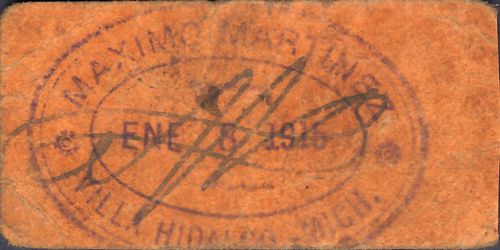 M3072 Máximo Martínez 2c
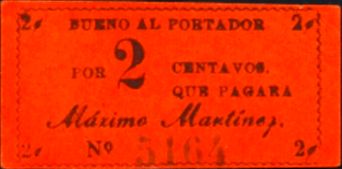
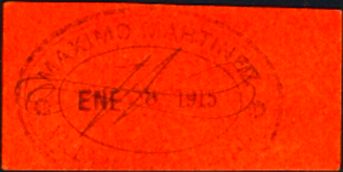
M3072 Máximo Martínez 2c
| from | to | total number |
total value |
||
| 2c | number horizontal includes numbers 3051 to 5164CNBanxico #11587 |
Porfirio Peña
This is a 5-centavos note printed on white cardboard, matching the line designs and featuring four flowers in the corners. The example shown here is numbered with the characteristic blue-green ink.
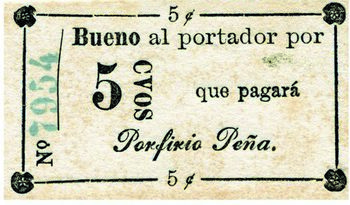
M3073.5 5c Porfirio Peña.
| from | to | total number |
total value |
||
| 5c | includes number 7954 |
E. Alanis Sucesores & Cía.
The only evidence available is two 10-centavos bills, printed on pink cardboard and sealed and signed on the back.
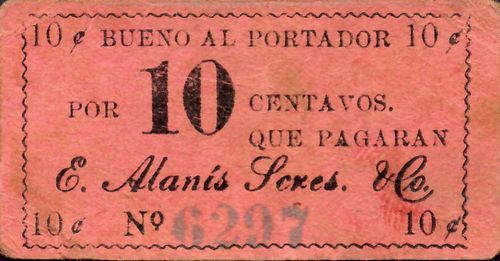
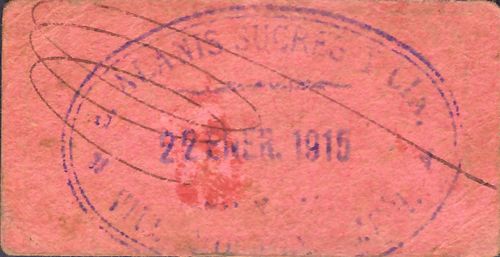 M3070 10c E. Alanis Sucres y Cía.
| from | to | total number |
total value |
||
| 10c | includes numbers 1966CNBanxico #11586 to 6297 |
(Based on Ricardo Vargas Verduzco, "Villa Hidalgo Private Notes: The Discovery of other Local Companies And Personalities" in USMexNA journal December 2025)
Tancítaro
Eligio Daza
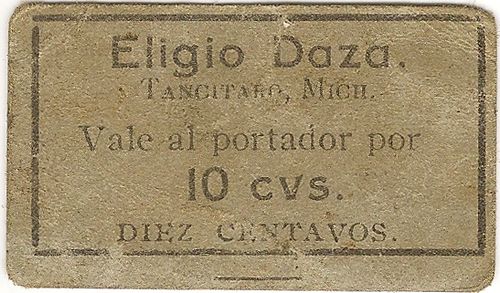 M3061 10c Eligio Daza
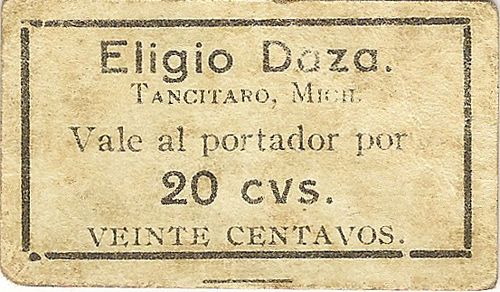 M3062 20c Eligio Daza
Enrique Chávez Barragán
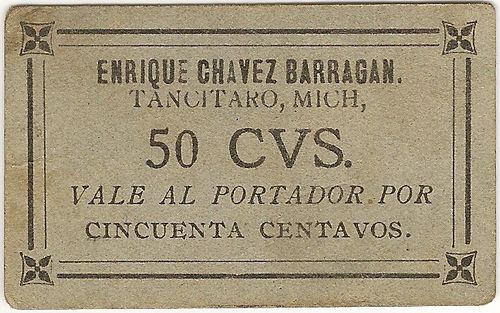 M3064 50c Enrique Chavez Barragan
Parácuaro
"El Cambio Mercantil"
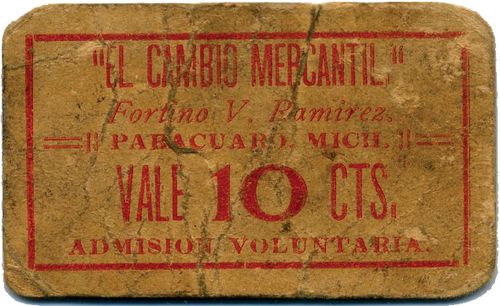 M3021 10c El Cambio Mercantil
Fortino V. Ramirez owned a store that used to be named “La Victoria”.
"La Guadalupe" Molino de Arroz
Francisco Farías Barriga, a wealthy man from Uruapan, had several diverse businesses. He owned a clothing store in downtown Uruapan called “El Puerto de Veracruz”. He was also one of the first men to produce coffee in the region, owning about 20,000 trees between Uruapan and Jicalán. He was one of the biggest rice producers with many haciendas such as La Guadalupe, Los Conejos, Cancita, Los Bancos and Tzindio.
Farias’ first rice mill “La Guadalupe” started operations in Parácuaro in 1898. It was operated by his corporation “Casa Farias”based in the Portal Carrillo, Uruapan, whose administrator was Jesús Ceja Torres, Jesús (2022) “Acercamiento al itinerario Armado de Cenobio Moreno Bucio: 1913” Tesis de Licenciatura UMSNH, Morelia..
This rice mill produced a 50c note in 1916.
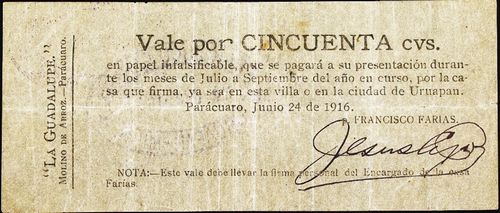
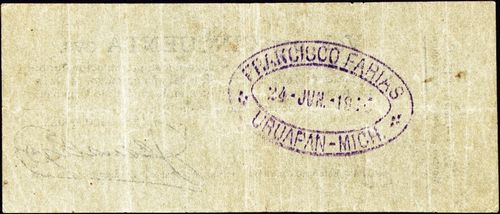 M3023 50c La Guadalupe
This note was dated 24 June 1916 and was redeemable in infalsificable from July to September, either in Parácuaro or in Uruapan, and as such is on a par with similar issues from Uruapan, Fernández y Cía., Hurtado y Cía. and La Camelia. it was signed by Jesús Ceja on behalf of the casa Francisco Faríasinformation from Ricardo Vargas, “Paracuaro, a small town in Michoacán with a rich numismatic history”, in USMexNA journal, June 2024.
| Jesús Ceja | 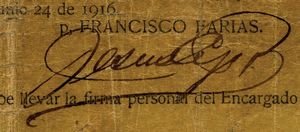 |
Tacámbaro
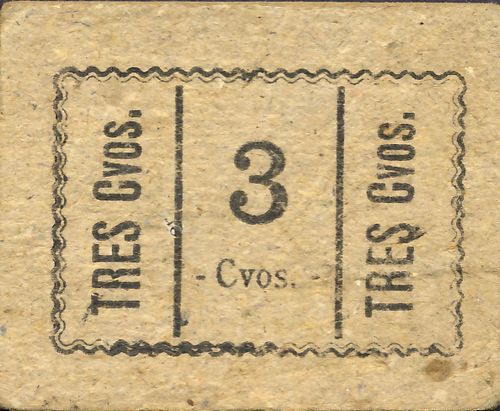
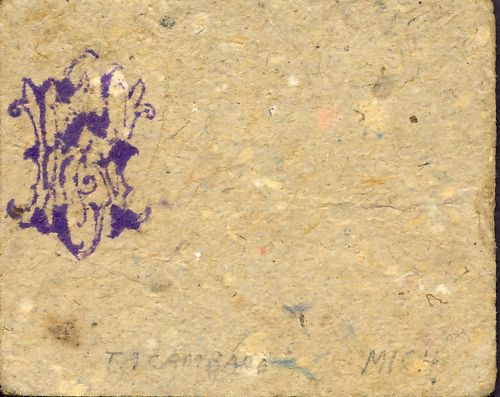 M3057 3c
Unknown origin
Leopoldo Guido
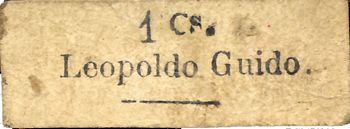 M3163 1c Leopoldo Guido