Movie money - Estado de Sonora (movie studios)
Some issues had the studio's name emblazoned across the note.
20th Century Fox
The Twentieth Century-Fox Film Corporation was founded on 31 May 1935 by the merger of Fox Film Corporation and Twentieth Century Pictures, and was one of the original "Big Five" among eight majors of Hollywood's Golden Age. The company's films retained the Twentieth Century Pictures searchlight logo on their opening credits as well as its opening fanfare, but with the name changed to Twentieth Century-Fox.
Earlier(?) small single portait Estado de Sonora notes were printed with the legend ' MADE FOR 20TH CENTURY FOX - FOR MOTION PICTURE ONLY'. Then the studio produced its own versions.
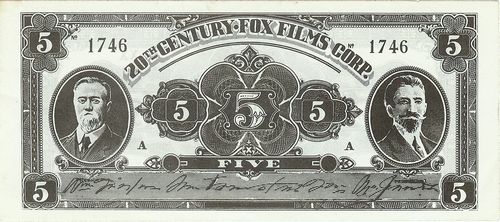

M Unlisted $5 20th Century Fox
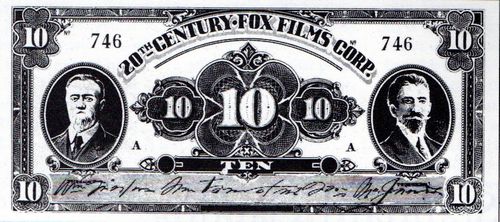 M Unlisted $5 20th Century Fox
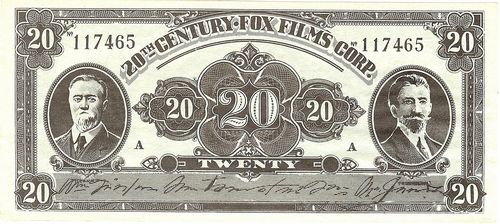
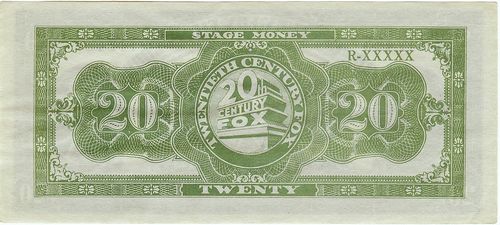 M Unlisted $5 20th Century Fox
These have the title '20th CENTURY-FOX FILMS CORP.' on the face, whilst both the portraits have been aged. Both Madero and Pino Suárez's hair and beard have been whitened, and Pino Suárez has a goatee. The 20th Century Fox logo appears in the centre of the reverse.
These are known in three series: on light, crisp white paper, on light grey paper and on heavier, light greenish paper.
| based on original note | front | back | ||||
|---|---|---|---|---|---|---|
| $10 | A | 1746 | 5 | black | light green | |
| 5 | black on light grey paper | dark green | ||||
| 5 | black on light greenish paper | dark green | ||||
| $10 | A | 746 | 10 | black | light green | |
| 10 | black on light grey paper | dark green | ||||
| 10 | black on light greenish paper | dark green | ||||
| $10 | A | 117465 | 20 | black | light green | |
| 20 | black on light grey paper | dark green | ||||
| 20 | black on light greenish paper | dark green | ||||
| $10 | A | 79541 | 100 | black and green | bright green | Benjamin Franklin in centre: White House at right |
| 100 | black and green on grey | bright green | ||||
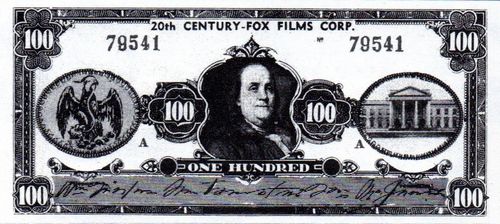
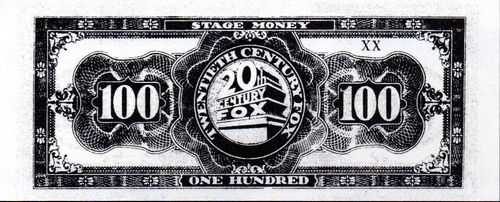
M Unlisted $100 20th Century Fox
This probably belongs to a different series. The face has Benjamin Franklin at the centre, the Mexican coat of arms on the left and the White House on the right.
| based on original note | front | back | ||||
|---|---|---|---|---|---|---|
| $10 | A | 79541 | 100 | black and green | bright green | Benjamin Franklin in centre: White House at right |
| 100 | black and green on light grey paper | bright green | ||||
Columbia Pictures
The brothers Jack and Harry Cohn and their business partner Joe Brandt founded the studio as Cohn-Brandt-Cohn (CBC) Film Sales Corporation on 19 June 1918 It adopted the Columbia Pictures name on 10 January 1924, went public two years later, and eventually began to use the image of Columbia, the female personification of the United States, as its logo.
In its early years, Columbia was a minor player in Hollywood, but it began to grow in the late 1920s and became one of the so-called "Little Three" among the eight major film studios of Hollywood's "Golden Age".
Certain small single portrait Estado de Sonora notes had the legend 'MADE FOR COLUMBIA PICTURES FOR MOTION PICTURE USE ONLY'.
Paramount Studio
Paramount Pictures is the second-oldest in the United States behind Universal Pictures. It dates its existence from the 1912 founding date of the Famous Players Film Company by Hungarian-born Adolph Zukor. On 8 May 1914, Paramount Pictures Corporation was founded by a Utah theatre owner, W. W. Hodkinson, who had bought and merged five smaller firms. In 1916, Zukor engineered a three-way merger of his Famous Players, the Lasky Company, and Paramount and merged the three companies into one, Famous Players–Lasky Corporation, although it continued to use the name "Paramount", as well. On 1 April 1927, the company name was changed to Paramount Famous Lasky Corporation and on 24 April 1930, it became the Paramount Publix Corporation. In the early 30s it went into receivership but in 1935 reemerged as the newly renamed Paramount Pictures Inc.
Certain large single portrait Estado de Sonora notes had the legend 'MADE FOR PARAMOUNT STUDIO FOR MOTION PICTURE USE ONLY'. These were followed by small single portrait issues.
Republic Studio
Republic Pictures Corporation was created on 23 September 1935 by Herbert J. Yates, a longtime investor in film (having invested in 20th Century Pictures at its founding in 1933) and owner of the film processing laboratory Consolidated Film Industries. In the depths of the Great Depression, Yates' laboratory was no longer serving the major studios, which had developed their own in-house laboratories for purposes of both economy and control, while the small, independent producers were going under in the face of increased competition from the majors combined with the general impact of the depressed economy. So In 1935 Yates decided to create a studio of his own to insure Consolidated's stability. Six surviving small companies were all in debt to Yates' lab and he prevailed upon them to merge under his leadership or else face foreclosure on their outstanding lab bills. Yates' new company, Republic Pictures Corporation, was presented to their producer-owners as a collaborative enterprise focused on low-budget product but Yates soon fell out with these “partners” and asserted full control.
Certain large single portrait Estado de Sonora notes had the legend 'REPUBLIC STUDIO'. Small single portrait notes are known with the legend 'Made for Republic Studios For Motion Picture Use Only'.
Universal Pictures Company
Founded on 30 April 1912 Universal is the oldest surviving film studio in the United States. Following the westward trend of the industry, by the end of 1912, the company was focusing its production efforts in the Hollywood area and on 15 March 1915 Universal City Studios opened on a 230-acre converted farm just over the Cahuenga Pass from Hollywood.
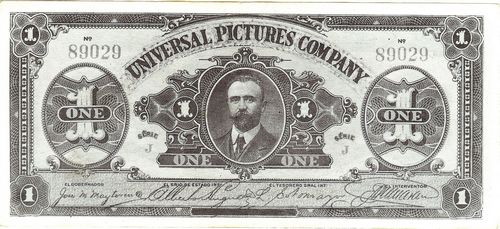
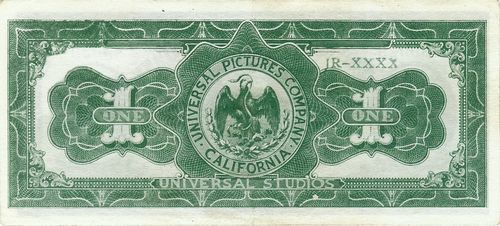 M Unlisted $1 Universal Pictures
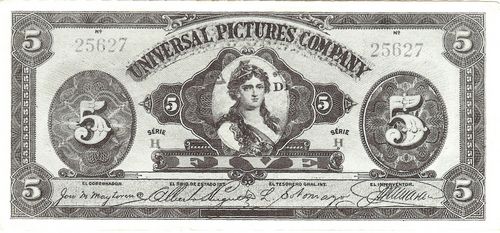

M Unlisted $5 Universal Pictures
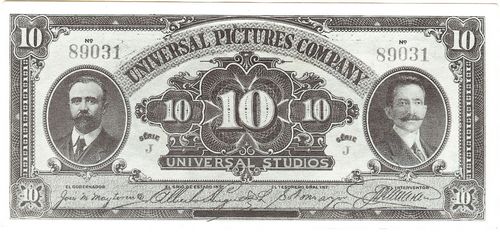
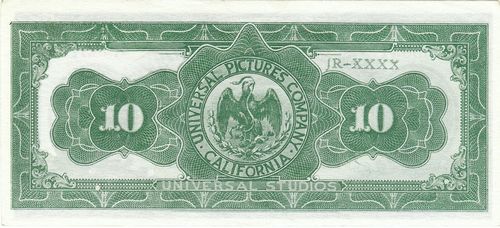
M Unlisted $10 Universal Pictures
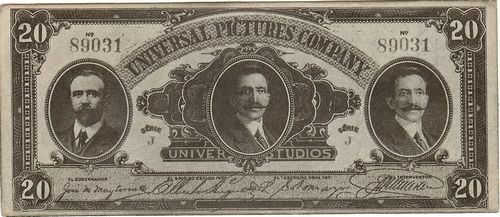
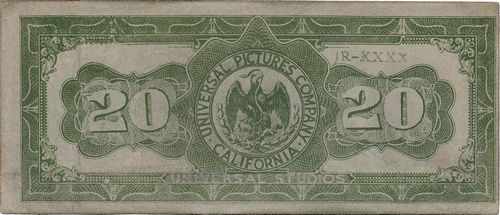
M Unlisted $20 Universal Pictures
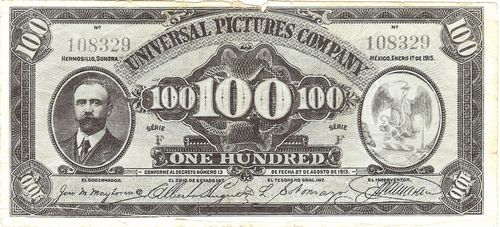
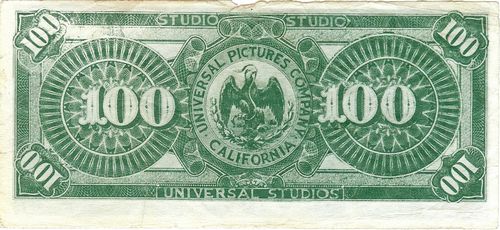 M Unlisted $100 Universal Pictures
These have 'UNIVERSAL PICTURES COMPANY' on face: 'UNIVERSAL PICTURES COMPANY - CALIFORNIA' surrounding the Mexican eagle on reverse. Notes are vknown printed on two types of paper: a white paper stock and a light grey paper stock.
| based on original note | front | back | ||||
|---|---|---|---|---|---|---|
| $1 | J | 89029 | 1 | black | green | Madero at centre |
| $5 | H | 25627 | 5 | black on light grey | green | allegorical woman from Banco de Sonora $5 note at centre |
| 5 | black on light grey | olive green | ||||
| $10 | J | 89031 | 10 | black | green | Madero at left, Pino Suárez at right |
| 10 | black on light grey | green | ||||
| 20 | black | green | Madero at left, Pino Suárez at centre and right | |||
| 20 | black on grey | green | ||||
| $5 | F | 108329 | 100 | black on light grey | bright green | Madero at left, eagle with snake at right |
| 100 | grey | bright green | ||||
Motion Picture Money
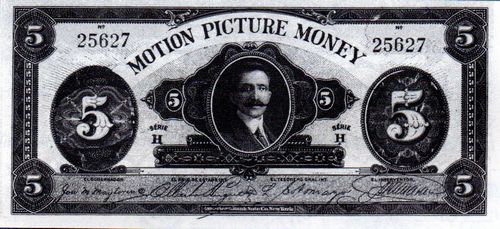
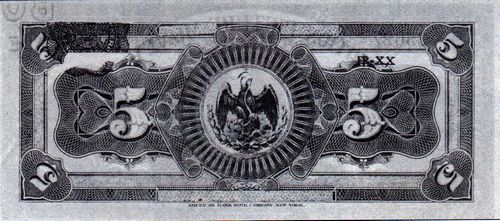
M Unlisted $5 Motion Picture Money
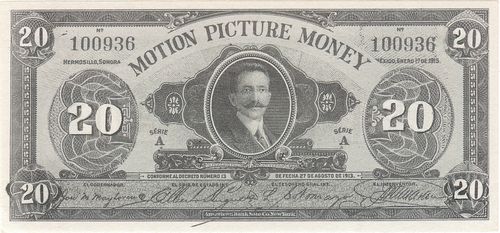
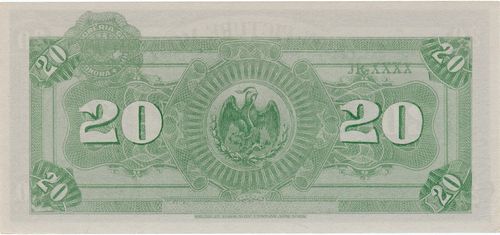 M Unlisted $20 Motion Picture Money
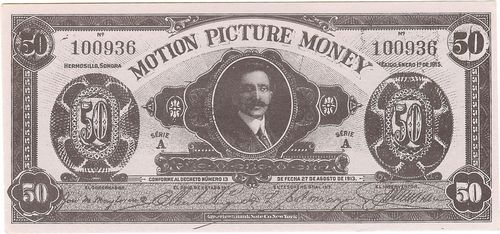
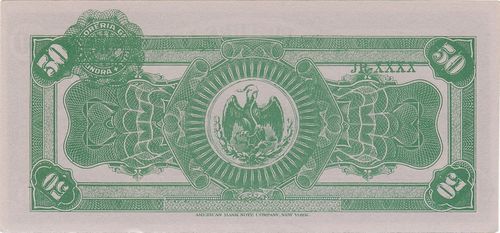
M Unlisted $50 Motion Picture Money
| based on original note | front | back | ||||
|---|---|---|---|---|---|---|
| $1 | J | 89029 | 1 | black | green | Madero at centre |
| $5 | H | 25627 | 5 | black | green | Pino Suárez at centre |
| $5 | A | 100936 | $20 | dark grey on light grey | green | Pino Suárez at centre |
| $50 | black on light grey | green | Pino Suárez at centre | |||
| $50 | dark grey on light grey | green | Pino Suárez at centre | |||
This is probably from a different issue.
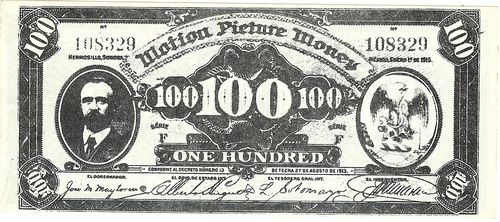
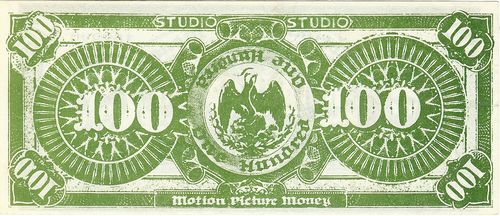
M Unlisted $100 Motion Picture Money
| based on original note | front | back | ||||
|---|---|---|---|---|---|---|
| $5 | F | 108329 | 100 | black | black | Madero at left, eagle with snake at right |