Paper money of Luisiana
Louisiana (Luisiana) was a province of New Spain from 1762 to 1801. The area had originally been claimed and controlled by France: Spain secretly acquired the territory from France near the end of the Seven Years' War by the terms of the Treaty of Fontainebleau (1762) though the actual transfer of authority was a slow process, and after Spain finally attempted fully to replace French authorities in New Orleans in 1767, French residents staged an uprising which the new Spanish colonial governor did not suppress until 1769.
France ceded the territory of Louisiana to Spain in 1762 in the secret Treaty of Fontainebleau and For four decades Spain strived to develop its province, because its products were desirable and it was the key to the defence of Mexico and Texas. However, Louisiana was later and briefly retroceded back to France under the terms of the Third Treaty of San Ildefonso (1800) and the Treaty of Aranjuez (1801). On 14 October 1802, King Charles IV of Spain published a royal bill, effecting the transfer and outlining the conditions. Spain agreed to continue administering the colony until French officials arrived and formalized the transfer. After several delays, the official transfer of ownership took place at the Cabildo in New Orleans on 30 November 1803. Three weeks later, on 20 December, another ceremony was held at the same location in which France transferred New Orleans and the surrounding area to the United States pursuant to the Louisiana Purchase.
Paper money
Spain’s outstanding scientist during the eighteenth century, Antonio de Ulloa, served as the first Spanish governor of Louisiana from 5 March 1766 until November 1768.
Under the French domination, Louisiana had been flooded with paper currency that had once been officially recognized at three-fourths of face value. In practice the value rose and fell. When Ulloa arrived, paper currency circulated at a discount of nearly fifty per centRuth Ameda King, “Social and Economic Life in Spanish Louisiana, 1763-1783,” Unpublished Ph.D. Dissertation, History, University of Illinois, 1931, p. 149. According to Villiers du Terrage, Les dernières années de la Louisiane française, p. 137, commissaries in Louisiana from 1748 to 1765 issued about $1,541,105 in paper currency . Ulloa proposed to stabilize the paper at sixty-five per cent of par, but the inhabitants demanded full value. The new governor desperately offered seventy-five per cent in an attempt to retire the currency, but the Louisianians demanded all or nothing. They almost received nothing. The French government attempted to suspend payment on all bills of exchange issued since the 1762 cession. Only vigorous protests by the French administrators and the Spanish government caused France to withdraw her decree. But Ulloa faced numerous problems related to paper currency. Even his own troops refused the virtually worthless money.
By the time of Miró’s accession large amounts of paper currency still circulated, causing the speculation in money that had plagued Ulloa in 1766Caroline Maude Burson, The Stewardship of Don Esteban Miró, 1782-1792 (New Orleans, 1940), pp. 93-100
An English traveller, Francis Baily, wrote of the money:
These certificates are a species of paper-money drawn by the commanders of the different forts on this river on the treasury at New Orleans, and are paid away to workmen, soldiers, &c., instead of money, and are received by the merchants as such; so that they are a kind of bank notes (similar to what our navy bills used to be formerly) received upon the faith of government, though it must be observed that oftentimes there is no great sum of money in the treasury, and these certificates are returned unpaid, so that they generally bear a discount; and this discount is proportional to the degree of confidence put in the prospect of getting the money. Francis Baily, Journal of a Tour in Unsettled Parts of North America in 1796 and 1797 (London, 1856), pp. 286-290..
Baily was furious when forced to accept these certificates for merchandise he had delivered to Natchez.
So, the Spanish authorities, in turn, issued, or proposed to issue, paper on at least three occasions during their brief rule.
First issue(s)
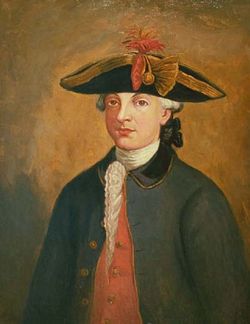
Esteban Rodríguez Miró y Sabater was appointed acting Governor of Luisiana on 20 January 1782 and became proprietary governor on 16 December 1785.
We have images of locally-produced two reales and eight reales of silver/one peso notes (so there was presumably at least a four reales and possibly half and one reales). The eight reales has the date 178- and both denominations were to be signed by the Contador and Tesoro and the eight reales was also to have the visto bueno of the governor, Esteban Rodríguez Miró.
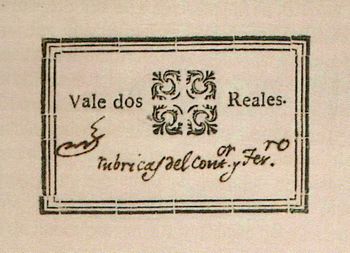
Vale for two reales
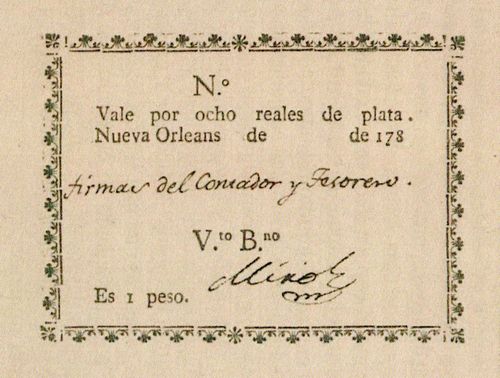
Vale for eight reales
Eric P. Newman, in his The Early Paper Money of America Eric. P. Newman, The Early Paper Money of America, Krause Publications, 1990, p. 162 states that “100,740 pesos in peso denominations of Spanish notes and an unknown amount of denominations in reales were received in New Orleans in June 1782 … and were intended to be used to pay soldiers” but does not give a source for this figure. He also has a third illustration of an eight reales note but Dr. Angel O. Navarro Zayas Dr. Angel O. Navarro Zayas, ”Spanish Colonial Paper Money in Puerto Rico and New Orleans”, in The Numismatist, October 2018, pp. 47-51 has shown that this actually belongs to the Spanish province of Puerto Rico.
These were possibly needed because the subsidy in hard cash (situado) In the Spanish Empire the term situado was used specifically to refer to the remittance or transfer of royal funds from one caja of the royal treasury to another to cover expenses of strategic importance. Between 1750 and 1769 the estimate average annual amount of situado to Luisiana was $150,000, between 1780 and 1789 $315,000 and between 1790 and 1799 $577,695 (Carlos Maricha and l, Matilde Souto Mantecón, “Silver and Situados: New Spain and the Financing of the Spanish Empire in the Caribbean in the Eighteenth Century” in The Hispanic American Historical Review, Vol. 74, No. 4 (Nov., 1994), p. 603). that the authorities regularly sent to pay expenses such as salaries for the troops was delayed.
These were distributed throughout the territory. Gilberto Antonio St. Maxent, the Comandante of the garrison at Galveston, wrote that his portion of one shipment arrived wet and were good for nothingEric. P. Newman, op. cit., p.162.
Issue of 1782
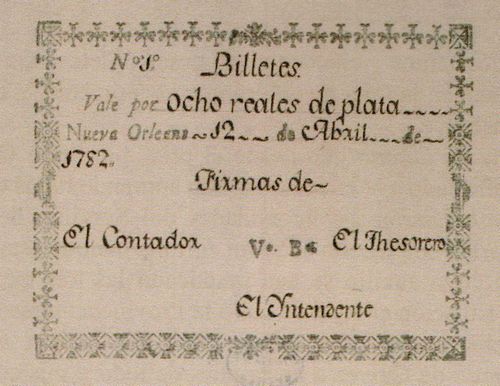
Billete for eight reales
On 12 April 1782 Martín Navarro, the Intendant of New Orleans, reported to José de Galvez, Secretary of State and President of the Council of the Indies, that he had had made $250,000 in paper money to supply with them the urgent attention of the Province due to the lack of money Archivo General de las Indias (”AGI”), Santo Domingo, 2609. “Duplicados de Intendentes del Ejército y de Real Hacienda. Florida y Luisiana.”..
This sum was composed of 100,700 notes in nine different values:
| Serial number | total number | total value | ||
|---|---|---|---|---|
| from | to | |||
| $1 | 1 | 50000 | 50,000 | $ 50,000 |
| $2 | 50001 | 70000 | 20,000 | 40,000 |
| $2.50 | 70001 | 90000 | 20,000 | 50,000 |
| $5 | 90001 | 95800 | 5,800 | 29,000 |
| $10 | 95801 | 98800 | 3,000 | 30,000 |
| $20 | 98801 | 99800 | 1,000 | 20,000 |
| $25 | 99801 | 100200 | 400 | 10,000 |
| $30 | 100201 | 100500 | 300 | 9,000 |
| $50 | 100501 | 100740 | 240 | 12,000 |
| 100,740 | $250,000 | |||
According to the example the notes were to be signed by the Comptroller (Contador), Treasurer (Tesorero) and Intendant (Intendente) of the Colony when issued.
These issues circulated for several years.
During his tenure Governor Mirò strove to develop the colony’s economy and applied to the Court of Madrid to encourage it through more liberal regulations. Thus, on 15 April 1786, he wrote “In Louisiana, there are strong houses which would be able to carry on all its commerce, if they were not restrained by the want of capital, and by the depreciated paper money which the wants of the country require to be put in circulation. This cause prevents them from undertaking the least mercantile speculation which would be attended by much risk. It is, therefore, astonishing that, notwithstanding these adverse circumstances, there should be so much commercial activity on this river, where at least forty vessels are always to be seen at the same time. I say that the operations of the merchants are impeded by the want of capital, because, not having specie at their disposal, they are obliged to purchase the agricultural productions of the country with paper money, and, as the planter sells them his crop at a very high rate, proportioned to the depreciation of the paper offered in payment, they cannot operate any sale of those productions in the European market, without losing thirty or forty per cent, and frequently seventy. This has occasioned losses, which have destroyed the fortunes of many merchants.”
Counterfeits
Some of these issues were counterfeited. In late 1782 Pedro Piernas, Lieutenant Colonel of the Infantry of Louisiana and Military and Civil Commander of the Fort and District of Natchez, 170 miles up the Missisippi from New Orleans, had noticed that counterfeit notes were in circulation and so, on 14 November, ordered all holders of supposedly false notes to present them for inspection and threatened any counterfeiter.
The subsequent investigation was conducted at Natchez, under the direction of Commander Piernas. The procedure followed conformed in general to the French system of legal procedure, although the report of the investigation was written in Spanish.
Josef Lavie, the surgeon, presented a $10 note which he had received in payment for a $3 treatment, and Francisco La Vesper presented another $10 note, that he had received from Juan Luis Dumont, a boy in Pedro Nitar’s store. Juan Galy, a Catalan, had received two $10 from Dumont. Dumont, in turn, said that he had got the notes from an Englishman, Alexandro Graydon The name is given as Greden throughout the case, but he signs has name as Graydon.. Pedro Nitar, the merchant, received two notes from an Englishman called William Jones (Guillermo Yons). Jeremiah Bryan (Geremias Brayen) presented a $10 note that his wife had received from Graus Mories, who in turn had received it from Jones.
Graydon was a thirty-year-old carpenter from Pennsylvania whilst Jones was a thirty-year-old lathe-turner from Virginia, who lived at Graydon’s plantation outside Natchez. On 21 November Ensign Josef Campana was sent to the plantation and searched the house but found nothing. Graydon and Jones were arrested. On questioning, Graydon claimed that Jones was the counterfeiter and had shown him four tin stamps with which he made the notes. Graydon took the ensign to the place where he claimed Jones had made the notes but they found nothing.
On 23 November Nataniel Ive, an eighteen-year-old Virginian who lived with Graydon and Jones, whilst learning to be a carpenter, gave evidence. He claimed that two days earlier Graydon had taken him into the woods and shown him “a machine which was in a way a press, with two small wheels, several tools, or small instruments, and three plates to print”. Graydon has said that he wanted Ive to help him as Jones had to go to Opelousas with part of the notes that they were making. He showed Ive three plates, for 1 real, 2 reales and $2.50, and two notes, saying “see here these that I have manufactured and no one can tell that they are counterfeits and so if thou art willing to help me thou will have (money) to spend without any risk because it is impossible that it could be discovered that they are counterfeit”. Ive declined because of the danger involved and Graydon asked him never to divulge anything, which Ive would have done because of what Greden had taught him until he realised that that would make him an accomplice.
Ive went with the interpreter, Adjuntant Estevan Minor, and they found the instruments in a place four leagues from the fort. They found “four engraved tin plates, of the dimensions of the ten peso notes, the two and a half, the two real, and the one real, with the engraving of the notes that he had for printing them, and between them one of the finished two and one half peso notes, besides two punchers, or burins, and a small gourd vessel with a composition for the ink, and also the wooden machine which served as a press for the operation”.
On 25 November Jones gave his evidence and confessed to making the dies. He did not recall how many notes he had made but it was approximately seven $10, ten $2½, and 15 each of the one and two reales. A third man, John Kennedy (Juan Canadi) had contributed by putting the corresponding numbers on each.
After the completion of the investigation at Natchez, on 31 December 1782, the full report of these proceedings, along with the four accused, Graydon, Jones, Kennedy and Dumont, was forwarded to the seat of colonial government in New Orleans. There, in the court of governor Miró, the proof of the charges against the accused, brought out in the Natchez investigation, was reviewed and approved. The court sentenced Graydon and Jones to death, and Kennedy and Dumont to six year’s exile from the colony and surrounding territory. Grayden and Jones were publicly hanged on 15 August 1783”Index to the Spanish Judicial Records of Louisiana LXX” in Louisiana Historial Quarterly, vol. 19, July 1936.
Luis Wetsell was captured in Natchez on similar charges in 1792 Gayoso to Carondelet, No. 172, Natchez, 15 September 1792, AGI, PC, leg. 41.
Withdrawal
New Orleans’ prosperity was checked when on 21 March 1788, a fire broke out in the house of the military treasurer, Vicente Jose Nuñez, and reduced to ashes 856 buildings, which were the stores of all the merchants, and the dwellings of the principal inhabitants, the Cathedral, the Convent of the Capuchins, the Townhall, the watch-house, and the arsenal with all its contents
A royal Order of October 1788 ordered the redemption of all Spanish paper money from 16 January 1789 Eric. P. Newman, op. cit., p.162.
Miró surrendered his governorship at the end of 1791 to return to Spain and serve in the Ministry of War.
Issue of 1796
Another fire on 8 December 1794 destroyed 212 of the best houses, with most of the warehouses, including two of the King that contained the garrison’s supplies, and almost all the shops.
On 26 December 1794 Francisco Rendón, Intendant of the Army and Royal Treasury of the Province, proposed to Diego de Gardogui, the Spanish Miniester of Finance, the creation of $1,000,000 in royal vouchers (vales reales) The Spanish government had already been issuing vales reales in Spain since 20 September 1780. It made two issues in 1795, one for 16,000,200 pesos on 16 January and another for 18,000,000 pesos on 8 September and would make a further issue of 30,000,000 pesos on 4 March 1795. For each of these many issues, different paper certificates were made based on intaglio engravings with different models, that had to be renewed annually For security reasons, the production was done in the Real Calcografía. José Ximeno was the creator of several of the designs and Lorenzo Sánchez Mansilla and José Assensio the most assiduous engravers. as an easy and costfree way of relieving the distress caused by the fire of 8 December AGI, Santo Domingo, 2643, ”Expedientes de Real Hacienda e instancias de partes”, 163.
The vouchers would either be sent to the province or printed there. The distribution would be “between the owners of the houses, and warehouses, which the fire had destroyed, in proportion of their losses, and to the securities that they can give for the payment of what they receive, having to be stipulated with all the precise condition, that they will rebuild in brick, covering their buildings either with roofs of the same, or already with ceramic tile, and in no way with wood, and sign the mortgage of the houses that have to give, apart from other assets, or also mortgage guarantees, with which they will ensure the payment of the one that is lent to each neighbour. The vouchers would be accepted for the payment of dues and withdrawn at the rate of $125,000 a year over eight years, starting from the third year of their issue. It was proposed that the million pesos be composed of
| total number | total value | ||
|---|---|---|---|
| $25 | 8,000 | $ 200,000 | |
| $30 | 3,333 | 1/3 | 100,000 |
| $40 | 2,500 | 100,000 | |
| $50 | 2,000 | 100,000 | |
| $60 | 1,666 | 2/3 | 100,000 |
| $70 | 1,428 | 40/70 | 100,000 |
| $80 | 1,250 | 100,000 | |
| $90 | 1,111 | 10/90 | 100,000 |
| $100 | 1,000 | 100,000 | |
| 22,290 | $1,000,000 | ||
On 24 June 1795 a Royal decree authorised the issue AGI, Santo Domingo, 2643, ”Expedientes de Real Hacienda e instancias de partes”, 163.
The vouchers have the legend ”Voucher by the King N. S. to the bearer of this [ ] pesos that are part of the million created by His Majesty for the relief of this Province in 22,291 numbered vouchers of various amounts that comprise it and must run and circulate in the Province as the usual and effective currency until its reimbursement and destruction in accordance with the rules established in the Royal Decree addressed to the Council of the Indies on 24 June 1795. (Vale por el Rey N. S. al Portador de este [ ] pesos que hacen parte de millón creado por S. M. para socorro de ésta Provincia en 22291 numeros de varias cantidades que le componen y han de correr y circular en ella como la moneda usual y efectiva hasta su reintegro y extincion conforme á las reglas establecidas en Real Decreto dirigido al Consejo de Yndias en 24 de Junio de 1795.)”
All the notes were to be made in the size of one-fourth of the full sheet (210 × 152 mm). The $50, $60 and $80 notes were designed by one of the most important Spanish painter and draughtsman at the time, Luis Paret y Alcázar, whilst the $25, $30, $40, $70, $90 and £100 were designed by José Jimeno [Ximeno]. All were engraved by José Asensio.
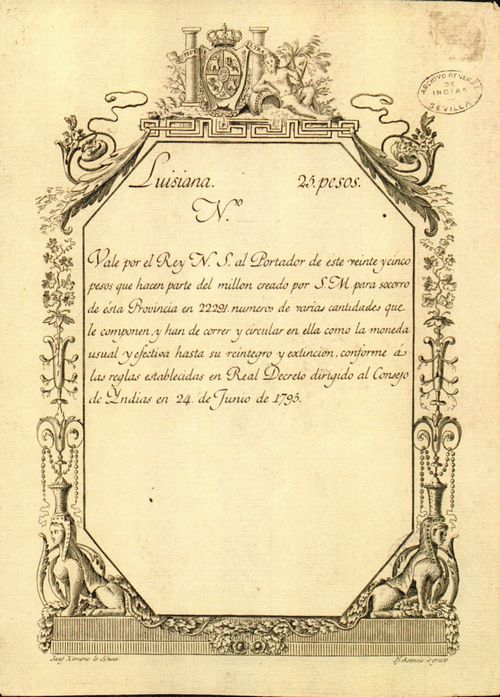
Vale for 25 pesosAGI, MP-Monedas, 9, ”Vale de 25 pesos para la Luisiana”
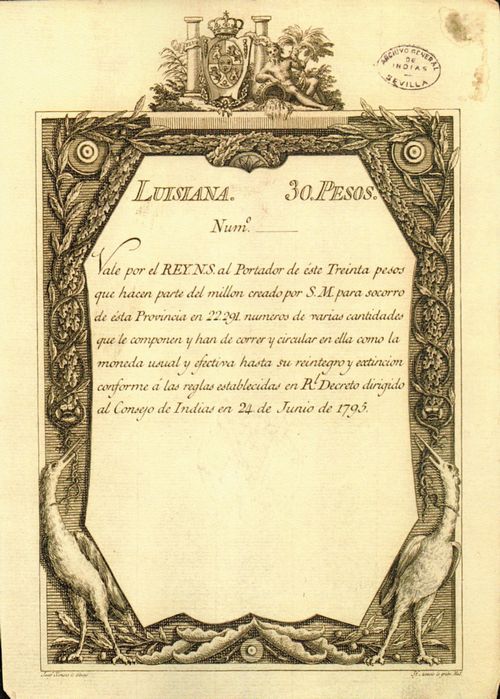
Vale for 30 pesosAGI, MP-Monedas, 10, ”Vale de 30 pesos para la Luisiana”
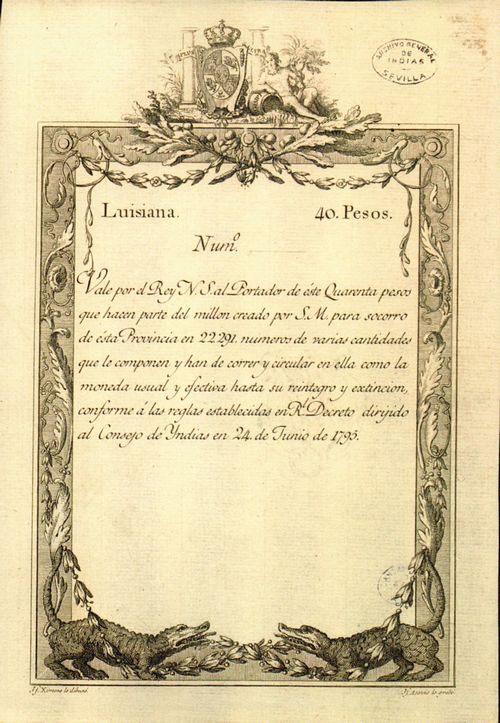
Vale for 40 pesosAGI, MP-Monedas, 11, ”Vale de 40 pesos para la Luisiana”
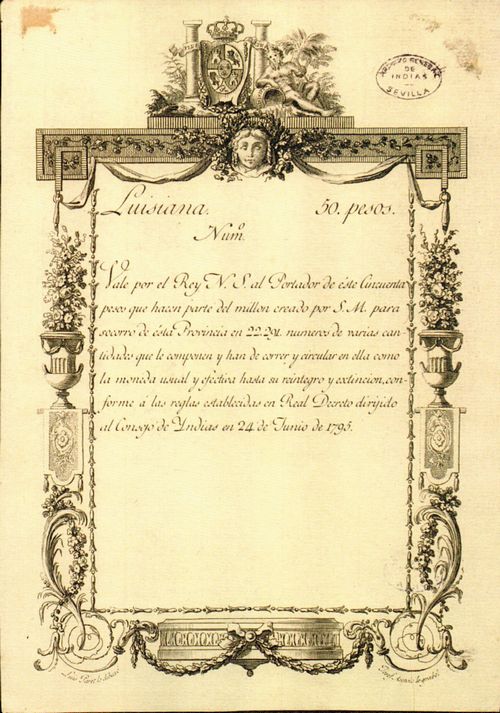
Vale for 50 pesosAGI, MP-Monedas, 12, ”Vale de 50 pesos para la Luisiana”
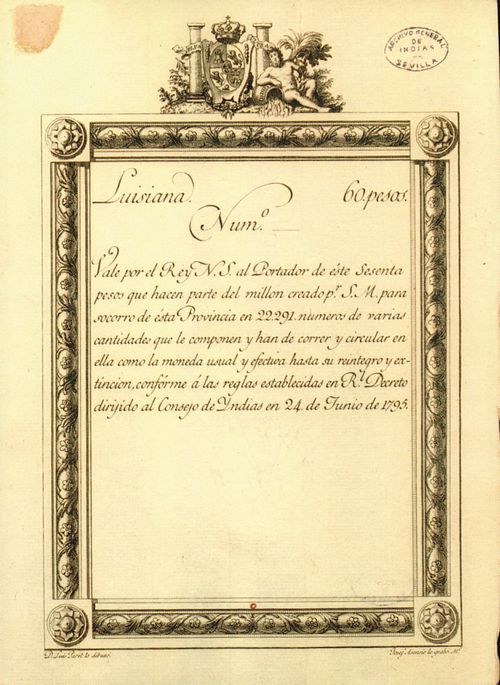
Vale for 60 pesosAGI, MP-Monedas, 13, ”Vale de 60 pesos para la Luisiana”
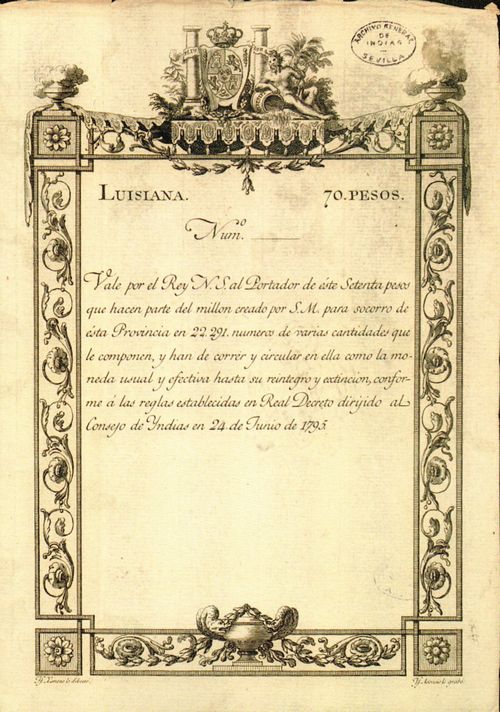
Vale for 70 pesosAGI, MP-Monedas, 14, ”Vale de 70 pesos para la Luisiana”
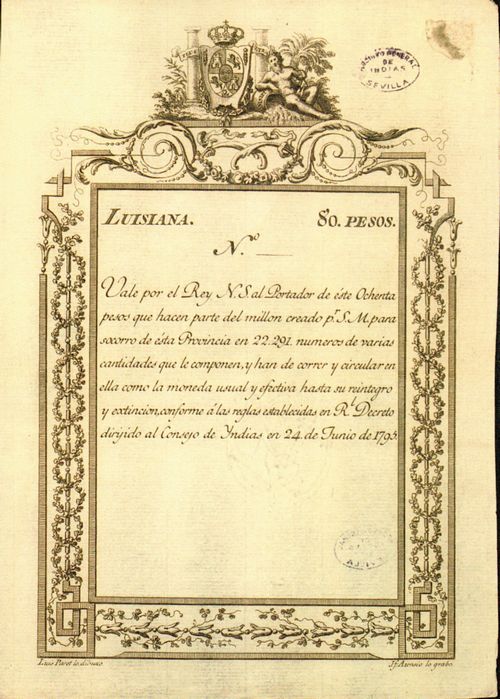
Vale for 80 pesosAGI, MP-Monedas, 15, ”Vale de 80 pesos para la Luisiana”
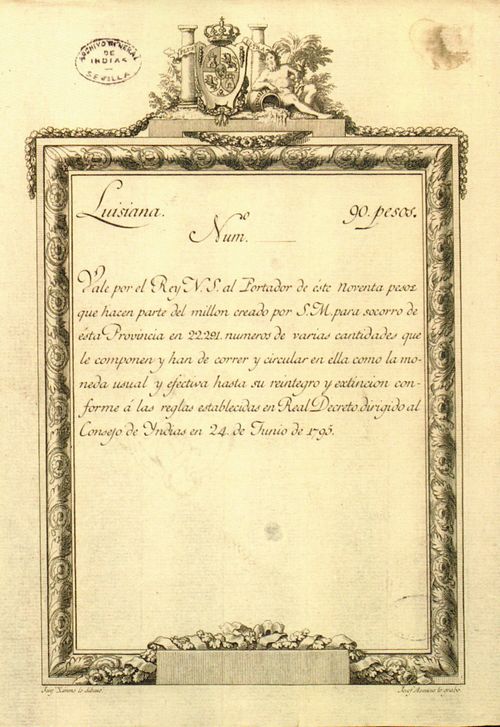
Vale for 90 pesosAGI, MP-Monedas, 16, ”Vale de 90 pesos para la Luisiana”
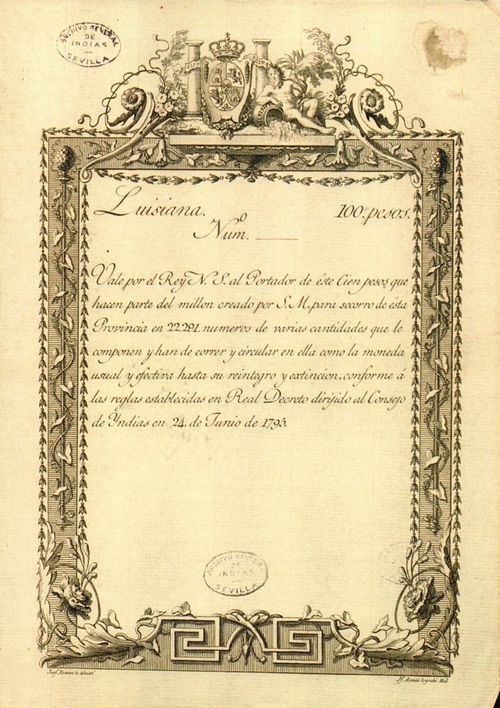
Vale for 100 pesosAGI, MP-Monedas, 17, ”Vale de 100 pesos para la Luisiana”
All notes have a header with the Spanish coat-of-arms between the Pillars of Hercules and the legend ‘PLUS ULTRA’, similar to the reverse of contemporary coins, with the addition of an old man leaning on an amphora with flowing water, representing the river Mississippi.
In order to distinguish between the denominations each has a different ornate border, a few with pairs of animals: sphinxes ($25), spoonbills ($30) and alligators (£40).
To prevent counterfeiting the paper would be watermarked CAROLUS, each denomination would have a capital letter, from A to I, and there would be secret marks, of which the two signatories would be given sealed copies AGI, Santo Domingo, 2643, ”Expedientes de Real Hacienda e instancias de partes”, 169. The Royal decree also provided for regular revalidation. “The Governor and Intendant of Louisiana shall designate every two years, or more often if it is convenient or there is a well-founded suspicion of fraud, a time when the vales are presented to them for recognition." To this end, the notebook containing the contraseña should be kept under lock and key, and with sufficient instructions on how to use it, in the General Treasury.
Finally the notes were be signed by the Governor and the Intendant of the Province or those who exercise such functions.
The vales were dispatched from Spain in March 1796 AGI, Santo Domingo, 2643, ”Expedientes de Real Hacienda e instancias de partes”, . In addition to the numbers requested 444 in the different denominations were printed and sent, to serve as ‘replacement notes; for any misprints or other errors.
| Serial number | total number | total value | Replacements | ||
|---|---|---|---|---|---|
| from | to | ||||
| $25 | 1 | 8000 | 8,000 | $ 200,000 | 160 |
| $30 | 8001 | 11332 | 3,332 | 99,960 | 66 |
| $40 | 11333 | 13832 | 2,500 | 100,000 | 50 |
| $50 | 13833 | 15839 | 2,007 | 100,350 | 40 |
| $60 | 15840 | 17504 | 1,665 | 99,900 | 33 |
| $70 | 17505 | 18931 | 1,427 | 99,890 | 28 |
| $80 | 18932 | 20181 | 1,250 | 100,000 | 25 |
| $90 | 20182 | 21291 | 1,110 | 99,990 | 22 |
| $100 | 21292 | 22291 | 1,000 | 100,000 | 20 |
| 22,291 | $1,000,000 | 444 | |||
However, on 1 April 1796 the Intendant of Luisiana reported AGI, Santo Domingo, 2643, ”Expedientes de Real Hacienda e instancias de partes”, that, in accordance with a directive from the Governor, he has suspended the circulation of the issue. The reasons were firstly, that many of the buildings, as belonging for the most part to the more affluent class, were already restored, secondly, that for some months before in any public or private obligation the creditors had demand an express formal clause that they must be paid in minted silver, and not in some other kind of currency, and thirdly, because of the suspicion of among the many foreign nationals living in the colony More British and French people came to Louisiana under Spanish rule than Spaniards. Only the immigration of Canary Islanders brought a significant number of Spanish-speaking colonists. were some capable of counterfeiting. The Intendant seems to have discounted a native tendency to counterfeit.
It should be noted that these vales were intended to address the reconstruction problems caused by the fires, rather than, as with the earlier issues, to compensate for a temporary shortage of small change. Hence the higher values of the individual notes, the idea that they would circulate for up to a decade, and the ease with which the proposal was dropped, when circumstances changed.
As a consequence the vales were to be left in the treasury (Reales Caxas) until it was decided whether to return them or burn them AGI, Santo Domingo, 2643, ”Expedientes de Real Hacienda e instancias de partes”,.
Most of the foregoing is based on the work of Dr. Angel O. Navarro Zayas, who researched the paper money of Spanish Louisiana in the General Archive of the Indies in Seville, Spain, in 2020 and has published his findings in various places, including his Historia Documental del Papel Moneda Español en Luisiana (Siglo XVIII), Puerto Rico, 2022,