La Violeta cigar factory
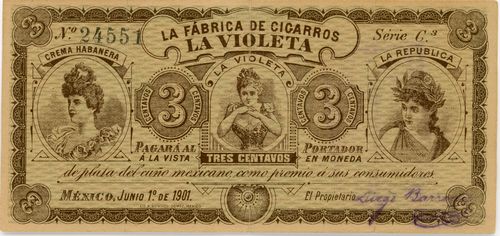
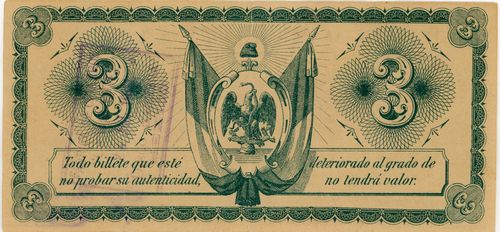 M698 3c La Violeta
| Series | from | to | Total number | Total value | ||
| 3c | A | |||||
| B | ||||||
| C | includes number 24551 |
This note, dated 1 June 1901, mentions three of its famous brands, La Violeta, Crema Habanera and La República, and offers three centavos in legal currency as a reward to purchasers. So not really paper currency.
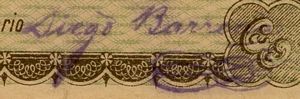
The signature is of the owner of the store, Diego Barrena.
|
However, in 1894, Barrena became involved in an operation counterfeiting about $400,000 worth of 50c revenue stamps. Barrena put up the capital whilst Clemente Xicoy and Enrique Riquelme, an engraver, actually produced the stamps. The scheme was uncovered when someone asked the Administración General del Timbre whether he could buy 50c stamps which were being offered to various casas de comercio at a 10% discount. The authorities then discovered that several establishments had bought these stamps which, on expert examination, were found to be falseAmong the businesses that had bought stamps and later went to court to get their money, totalling $2,601.50, back were José Castillo, Gerardo C. Silva, Gustavo Strück y Cía., F. Manuel y Cía., Caire Aubert y Cía., A. Richar y Cía., Signoret Honnorat y Cía., J. B. Ebrard y Cía. sucesores, A. Reynoud y Cía., S. Robert y Cía. and L. Fanden y Cía. Barrena promised to repay his share of $1,728.50 at $200 a month (El Noticioso, Primera Epoca, Núm. 36, 30 May 1894: El Siglo y Nueve, 30 May 1894}. Another newspaper reported “The sale of stamps, which amounts to 6,000 pesos, was made to several commercial houses: La Valenciana, Puerto de Tampico, a stall in one of the calles del Reloj. El Gran Oriental, casa de Benecke, casa de Scherer, casa de Struck', Mexico City, to the bacon shop on the corner of San Juan and La Escondida, to the Notary Public Vargas, to Mr. R. E. Ruiz, also a Notary Public; to the Puerto de Liverpool, to the Fábricas Universales and to La Primavera. … Mr. Luis Barroso also bought at fifteen per cent: Mr. Mariano Esnaurrizar sold a good quantity of stamps to an employee of the Customs, Mr. Victoria, on commission given to him by Barrena; the Notary Public of the 2nd Civil Court, a Mr. Olivares, recommended an individual so that they could buy at ten percent. Of the stamps that are in circulation, 2,943 have been collected, as of yesterday; as many, therefore, remain in the market (El Tiempo, 16 May 1894).. Around 6,000 stamps had been put into circulation El Tiempo, 16 May 1894. On 14 May 1894 a decree suspended the sale of 50c stamps for the rest of the fiscal year, and it was ordered that all such stamps should be collected, with the good stamps replaced with stamps of different values. The counterfeit stamps were finally incinerated in the Oficina Impresora de Estampillas on 27 December 1897El Tiempo, 3 January 1898. Diego Barrena was arrested and held incommunicado in the Belén prisonEl Noticioso, 13 May 1894. In June 1894 he (together with Clemente Xicoy and Francisco B. Chávez) was found guilty and sentenced to four years eight months in prison and a fine of three hundred and fifty pesosEl Tiempo, 8 June 1894. This was later increased to seven years two months and five hundred pesosEl Foro, Colección Tomo XLIV, Año XIV, Núm. 62, 30 March 1895. As Barrena could only be granted his freedom after two thirds of this term in late May 1896 he used a constitutional provision to obtain day release on parole on the grounds that he was severely repentant and was looking for workThe Two Republics, vol. XLII, No. 114, 12 May 1896: El Siglo Diez y Nueve, 22 May 1896. He (and Xicoy and Chávez) were then released on 16 October 1896El Mundo, Tomo I, Núm. 20, 17 October 1896. He obviously made good use of his time in prison because on 20 July 1898 he married Cristina Muñoz Campuzano, daughter of Col. Pedro Muñoz Campuzano, “the popular warden of Belem prison”The Mexican Herald, vol. V, no. 323, 21 July 1898. Barrena had a factory at Prolongación Ayuntamiento 10 (or 5ª del Ayuntamiento) making cigarros Imperiales de la Violeta, available for sale in shops, cantinas, cafes and restaurants and received trademarks in December 1901 El Popular, Año V, Núm. 1769, 5 December 1901 He died in Mexico City on 3 April 1953. |
 |
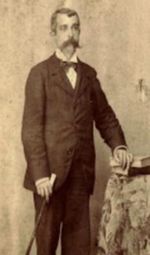 Diego Barrena Doncel was born in Montijo, Extremadura, Spain around 1860. He arrived in Mexico with no money but amassed $10,000 selling maps in various parts of the country